

New question types, stronger response quality features, AI improvements, and everything new on Conjointly from Q1 2026.
Here’s what’s new from the past quarter on Conjointly.
At a glance
- New question types:
- Implicit testing (alpha feature)
- Semantic differential is now available as a matrix grid subtype
- Quota checks for very flexible quota management
- Response quality features:
- Early detection of VPNs and nudging respondents to switch VPN off*
- Early detection and termination of malicious residential proxies*
- Sloppy-answer classification tab
- 12 other improvements in the response quality system
- For enterprise clients:
- A new manager role to oversee several teams
- More secure credit card payment handling with 3D Secure
- Ability to generate SOWs from the platform
- AI features:
- AI Helper can create segments, source relevant info from the guides, and more
- Editing formulas is easier with LLM-generated suggestions (just ask it what you want to insert)
- Creating and scheduling exports to Power BI
- Commonly requested improvements:
- The ranking question type allows for partial ranks and has more outputs like Borda count and two-candidate preferred vote for consensus-finding
- You can now pipe-in past answers using formulas inside prompts for conversational surveys so that the bot has the necessary context for informed questioning
- Reports now available with as few as 1 respondent included in the analysis
- Jump directly to any question in preview
- Switch screen sizes in preview (desktop/mobile/tablet)
- Timing data for answers to questions is now granular (in milliseconds)
- Several ways to present matrix grid questions on mobile: Carousel / Single file / Tabs
- Brand Tracker now covers the USA
When both “Detection of anomalous network activity” and “Terminate low-quality respondents early” are on. Always on when you buy sample from Conjointly.
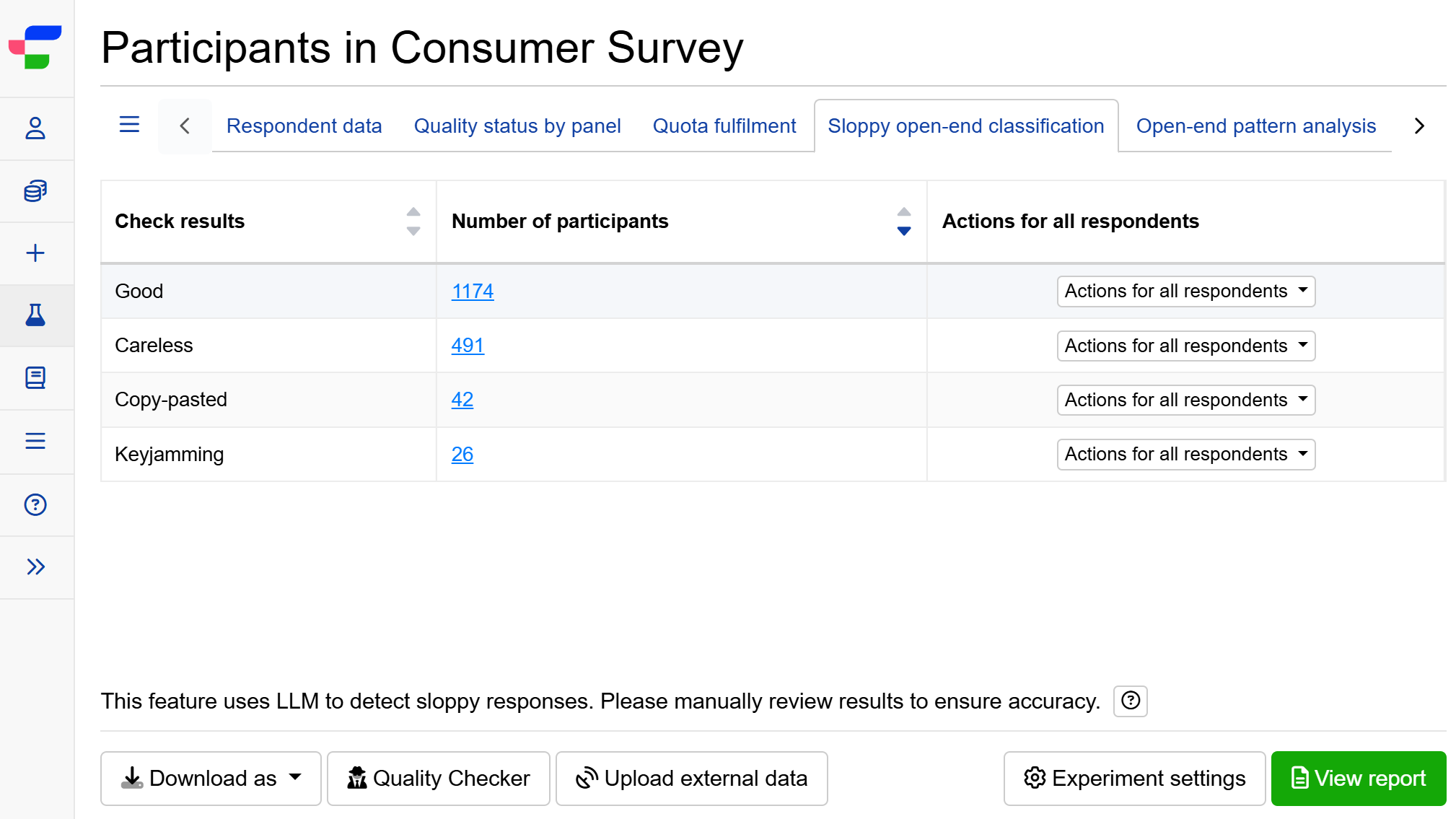
Sloppy open-end classification
Available when sloppy open-end detection is enabled
Open-end responses flagged as sloppy are now automatically classified by type, making it faster to understand patterns in low-quality entries and decide how to handle them in bulk.
💡 Tip: Ensure detection of sloppy open-ended responses is enabled in your active projects. This helps identify and exclude gibberish, keyboard mashing, and inattentive respondents from your final analysis.
Open-end pattern analysis
Available when sloppy open-end detection is enabled
You can now spend less time cleaning duplicate open-ends by simply reviewing groups of similar open-ended entries across participants.

Early detection of VPNs and malicious residential proxies
There are good and bad reasons for people to hide their real IP address, but when they come as respondents from panels, we want to know their location for quality verification.
Conjointly detects technologies like VPNs and proxies used for masking location. When you buy sample from us or when you turn on both “Detection of anomalous network activity” and “Terminate low-quality respondents early”, Conjointly now requires potentially legitimate VPN users to switch off their VPN (and leave an incognito window if they are in it).
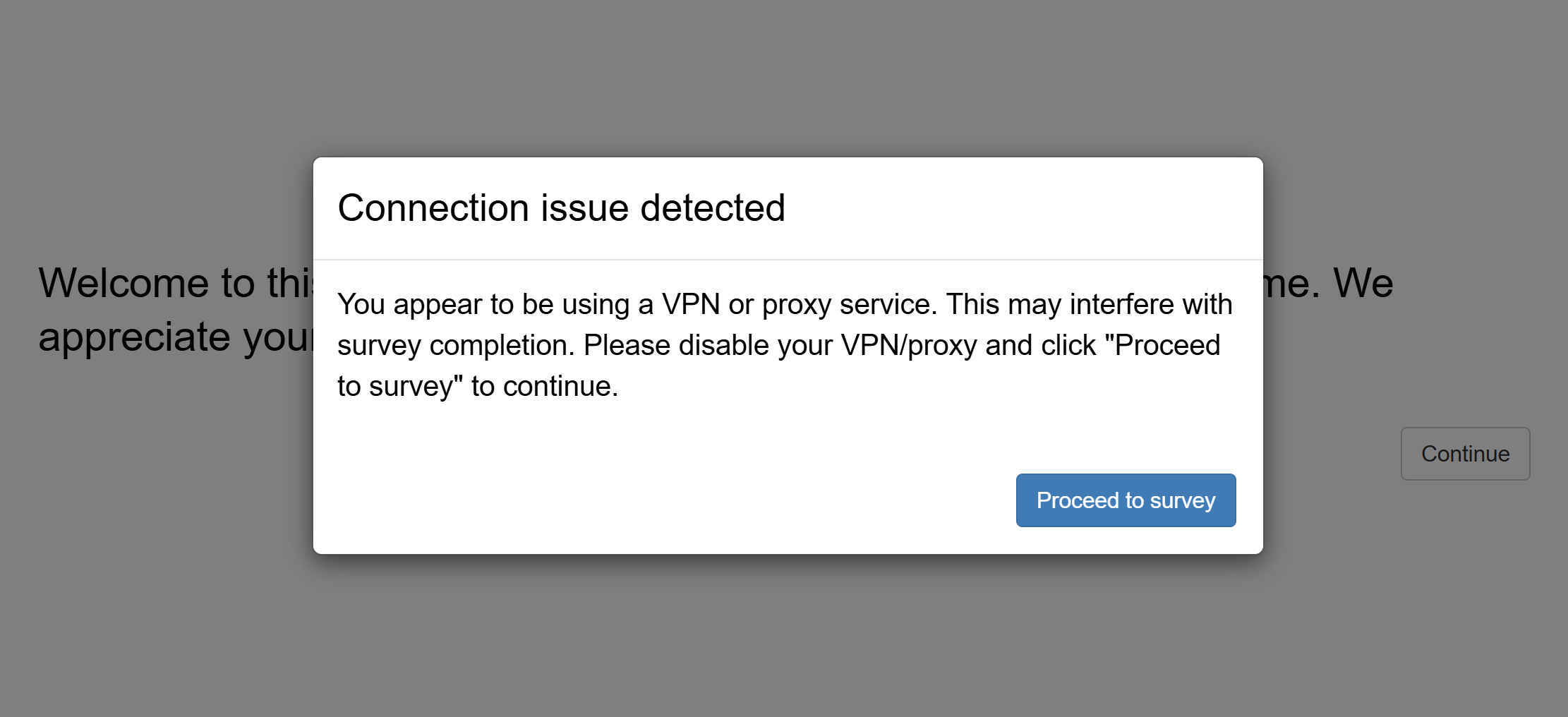
However, if they are using a malicious residential proxy, they will be terminated immediately.
Previously, these checks were performed only at the completion of the survey.
What does Quota check do?
Quota check lets you inspect quota fulfilment status at any point in the survey flow. Unlike other survey flow controls, it is entirely informational and does not redirect, terminate, or otherwise affect the respondent’s path on its own.
If you want to act on quota status (such as to screen-out, redirect, etc.), you must set that up separately by referencing it in display logic, specific survey flow controls, or formulas in subsequent questions.
The question type is perfect for complex quota management.
Questions or specific requirements? Let's book a chat.