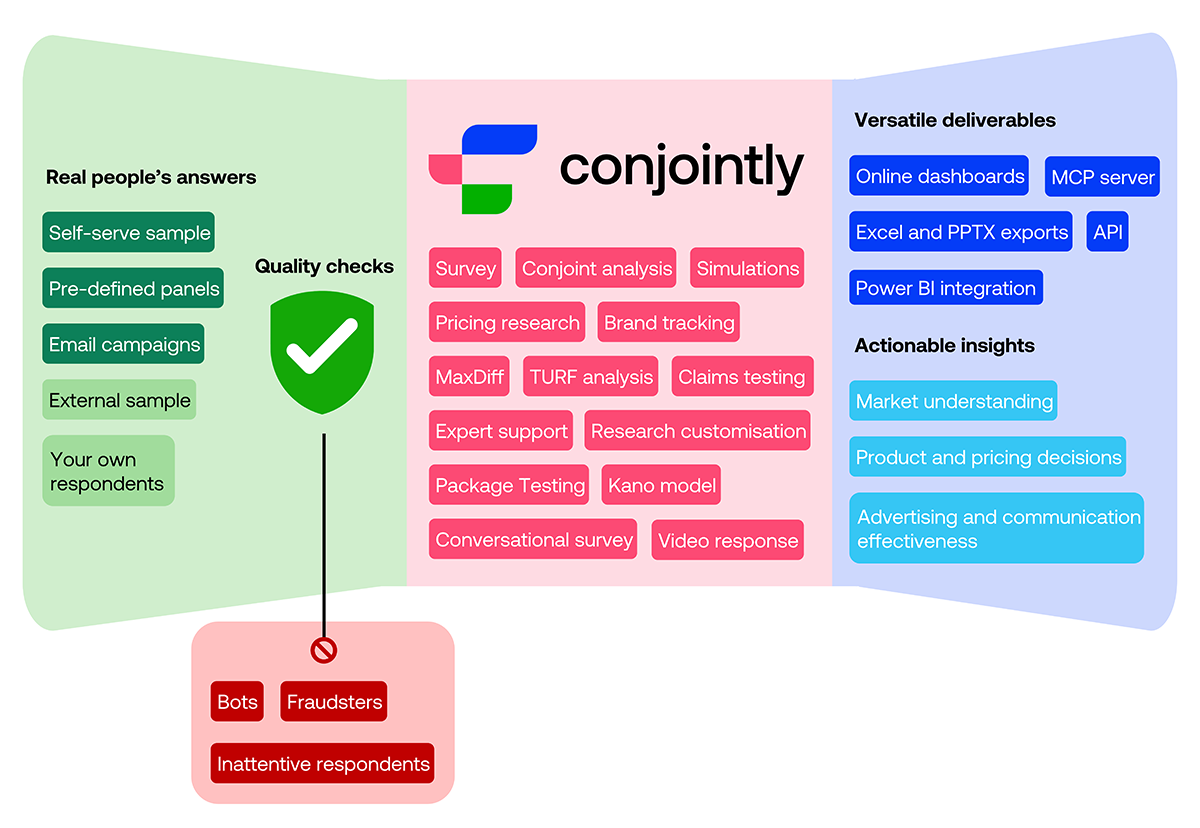

All the new things on Conjointly from Q3 2026
Self-serve sample C, Dial Testing, new question types, additional TURF analysis outputs, and many other improvements from Q3 2026.
View article
TURF Analysis: Building the Product Range That Reaches the Most Buyers
More products don't always mean more customers. Join our free TURF Analysis webinar to learn how to build the product lineup that reaches the widest audience, using a sparkling water example.
View articleMonthly newsletter
Get the latest updates about market research, automated tools, product testing and pricing techniques.
We (Conjointly) collect your personal details and other information in accordance with the Conjointly Privacy Notice. It is needed to send you electronic mail and subsequent communications. If you don’t provide this information, we may not be able to add you to the mailing list. You have rights to unsubscribe from the mailouts, correct your information, to make a complaint, and other rights, as per the Privacy Notice.

Are consumers passing on Ray-Ban Meta glasses?
Ray-Ban Meta glasses were dubbed 'pervert glasses' amid growing privacy concerns in 2026. Will real consumers pass on the product? We ran a concept test to find out.
View article
Benchmarking survey data against 2025 Australian election results
Conjointly surveyed 3,970 voters in Australia to compare online survey results and actual 2025 Australian election outcomes, revealing the value of survey research for political polling and opportunities to better align survey data with real-world behaviour.
View article
Qualitative research options available on Conjointly
Conjointly offers several ways to run qualitative research, from conversational surveys and video responses to open-ended questions, so you can match the method to the depth of insight you need.
View article
What is customer segmentation and how does it work?
Explore the core principles and six examples of customer segmentation, and follow a seven-step framework to build and validate a repeatable customer classification model.
View article
Conjoint analysis vs MaxDiff: When and how to use each method
A side-by-side look at what conjoint analysis and MaxDiff actually tell you, when to reach for one over the other, and pointers on combining both to get the most out of your research.
View article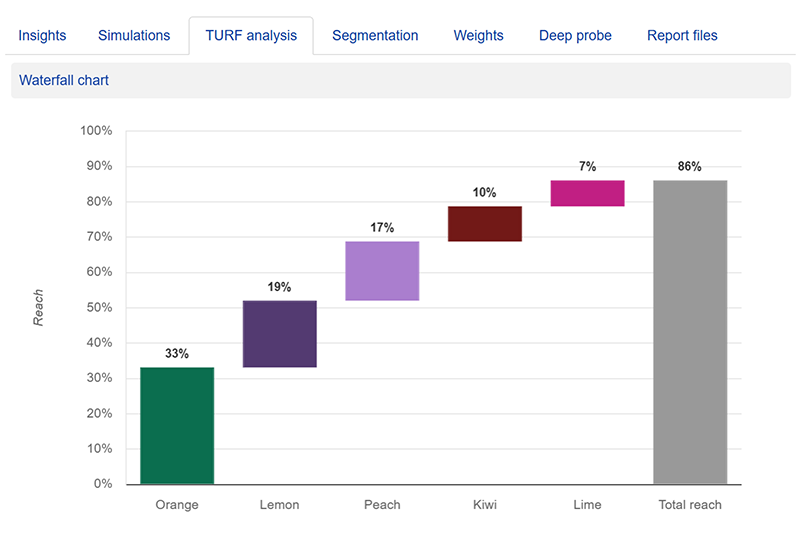
How to use TURF analysis to optimise your product range in 3 easy steps
Deciding which product options to add, keep, or drop? This guide covers 3 simple steps from building your survey to analysing the results so you can choose a product range that maximises customer appeal.
View article
Do you really need volumetric conjoint?
Volumetric conjoint asks respondents how many units of each product they would buy, rather than which single product they would pick. That extra realism is not free. Here is what the method genuinely adds, where it breaks, and how to tell whether your study needs it.
View article
Conjoint Analysis: Deep Dive into Results
Due to popular demand, Conjointly's Conjoint Analysis webinar is back. This time we focus more on the results: what they tell you, and what to do about them.
View article
All the new things on Conjointly from Q2 2026
A big quarter for conjoint. New question types, smarter quotas, and many other improvements from Q2 2026.
View article