Sloppy open-end classification
You can access the Sloppy open-end classification tab on your Participants page to review AI-powered classifications of open-ended responses, grouped by result category, and take bulk actions on respondents within each group.
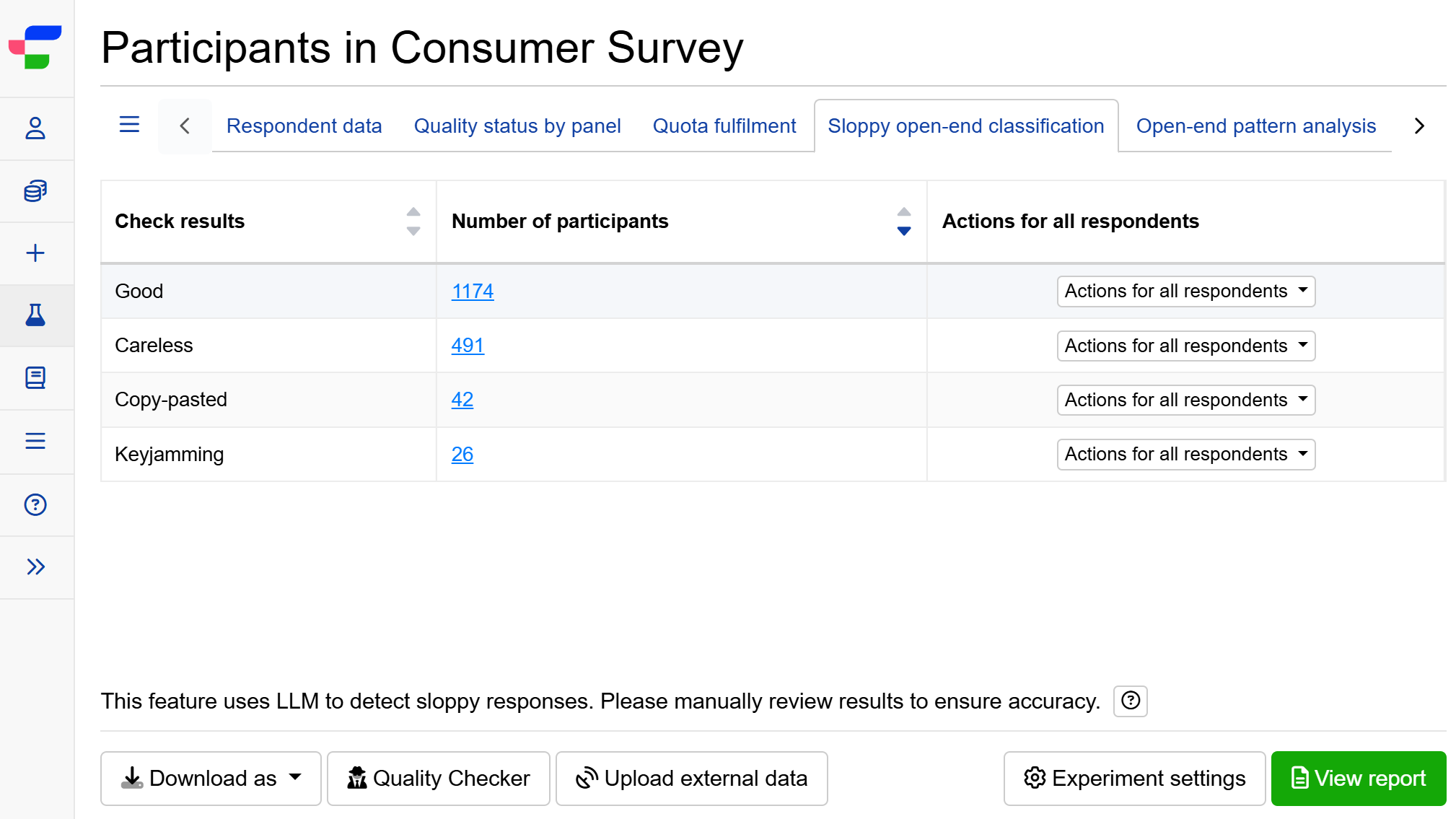
How it works
The feature uses a large language model to classify each participant’s open-ended responses into one of four categories:
| Category of responses | Signal | Description |
|---|---|---|
| Careless | open-end-careless | Responses that are overly brief, vague, or fail to address the question adequately |
| Copy-pasted | open-end-copy-pasted | Responses that appear to be copied and pasted from other sources |
| Keyjamming | open-end-keyjamming | Responses containing nonsensical or gibberish characters |
| Good | open-end-good | Responses that are relevant and related to the survey question |
Clicking the number of participants opens a modal where you can review each respondent’s response text, quality rating, and inclusion status, and exclude specific participants from your analysis as needed.
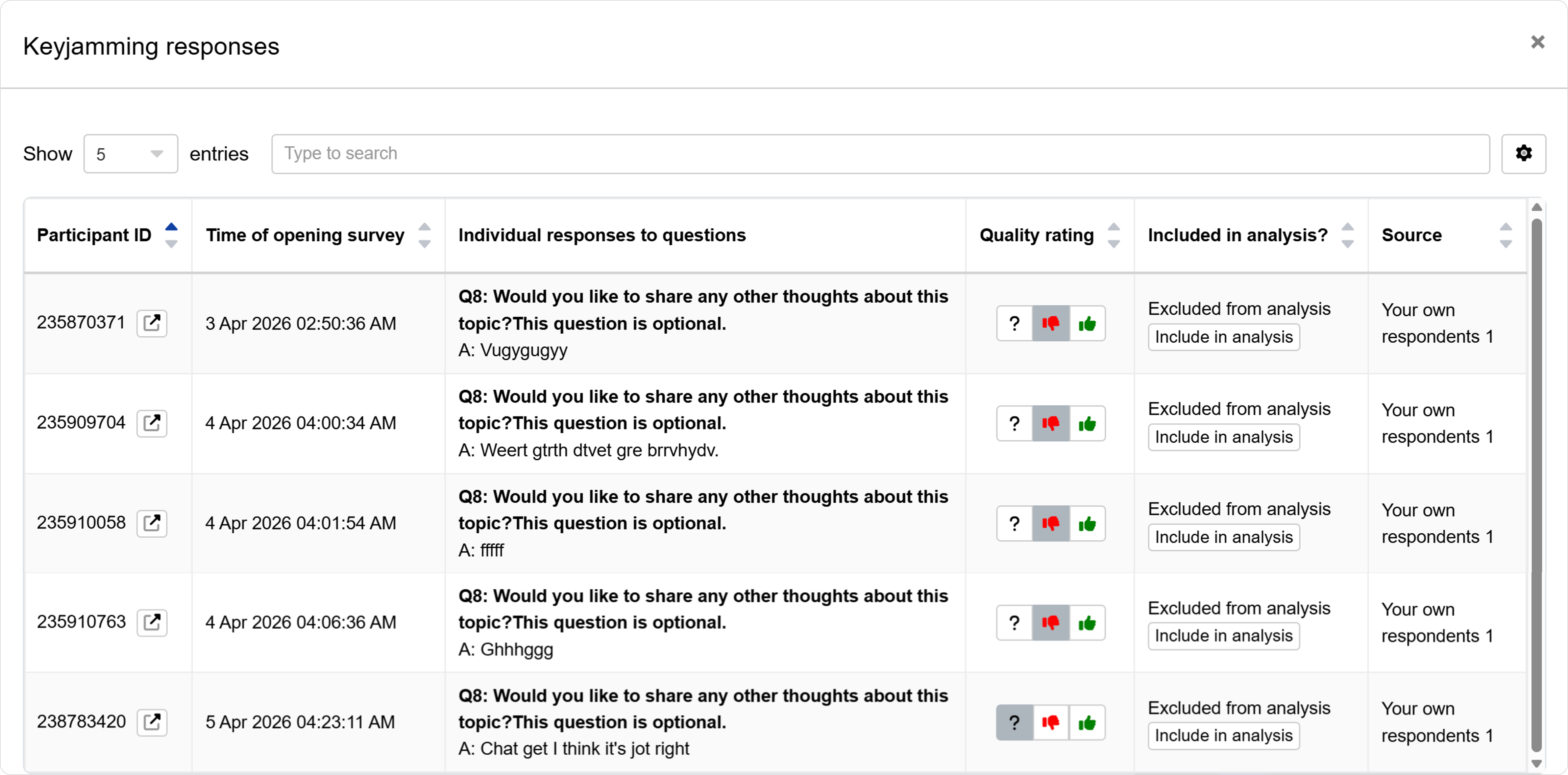
You can also click to apply inclusion, exclusion, or reset quality assessment actions to all respondents in that category.
When this feature is available
The Sloppy open-end classification tab is available when your experiment meets the following requirements:
- Your experiment includes at least one analysable open-ended question.
- Your team has not disabled LLM features in team settings.
- LLM features are not disabled for the primary owner of the experiment.
- Detection of sloppy open-ended responses is switched on.