Volumetric conjoint asks respondents how many units of each product they would buy, rather than which single product they would pick. That extra realism is not free. Here is what the method genuinely adds, where it breaks, and how to tell whether your study needs it.
Recently, we at Conjointly have noticed more questions about volumetric conjoint. The spike in interest coincides with the rise of AI-based Q&A functionality on Google, ChatGPT, and other platforms. We suspect that AI keeps mentioning “volumetric conjoint”, so it’s timely we address this topic.
Standard choice-based conjoint asks a respondent to pick one option from a set. That works for a car, a mortgage, or a mobile plan. It is a less realistic task a supermarket trolley because shoppers will buy two tubs of ice cream, a 12-pack of one soft drink plus a 2-litre bottle of another, and three frozen pizzas because the kids will not agree on toppings.
Volumetric conjoint changes the response task: instead of choosing one alternative, respondents enter a quantity against every alternative on the screen, including zero. You get not just the choice data, but how many units the category sells and how that total moves when you change a price, a pack size, or a promotion.
That sounds like it adds more realism. It is also harder to design, harder to model, and harder on respondents. Let’s dig in.
What volumetric conjoint asks respondents to do
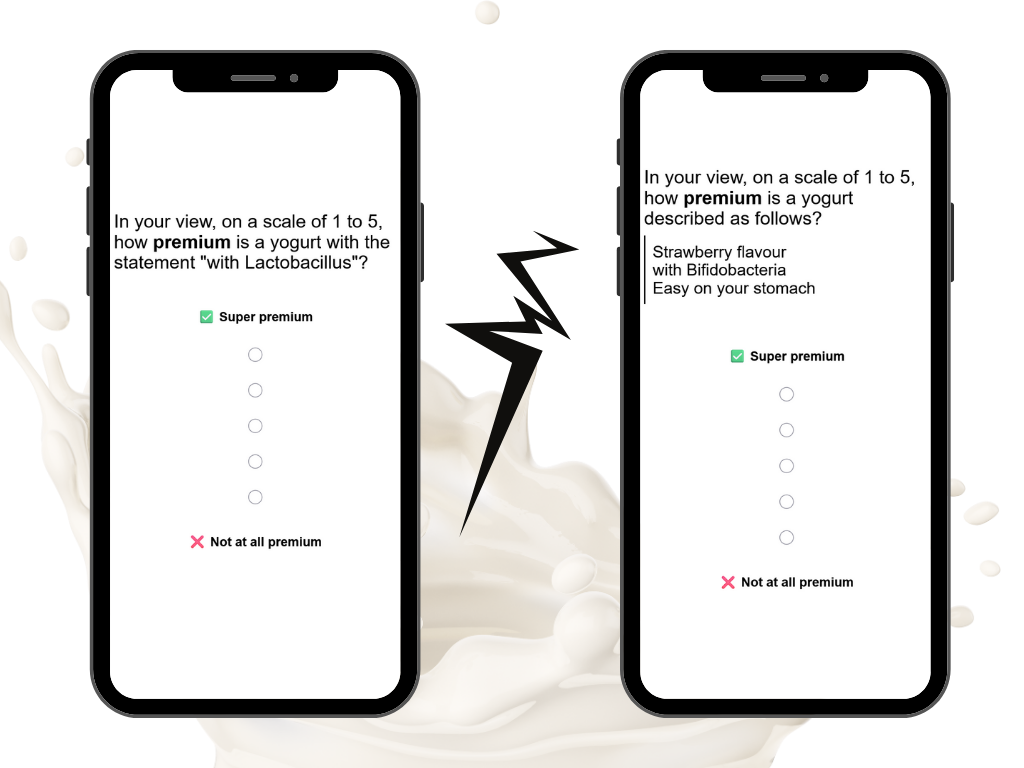
The task can look like a shelf or a web store. A respondent sees a set of product profiles described by attributes and prices, and next to each one there is a numeric box. The instruction is some version of: “If these were your only options the next time you buy, how many of each would you buy? Enter zero for any you would not buy.”
That change to the response task has two consequences:
Several alternatives can be positive at once. Economists call this multiple discreteness. Answers can be corner solutions (only one product bought) with interior solutions (two or more bought together).
Total volumes can be estimated. The sum across the shelf is a volume estimate (and it is modelled as dependent on the prices and attributes of the products).
Interior solutions are common. In Satomura, Kim and Allenby’s beverage packaging study, 48.2% of the 282 respondents produced an interior solution at least once, and 25.5% of all choices involved two alternatives rather than one.
Volumetric conjoint is not the same thing as constant-sum (chip allocation) conjoint, where the total to be allocated is fixed in advance. In volumetric conjoint the respondent chooses the total, which is what makes it useful for volume forecasting.
Why “how many” needs a different model
You cannot point a standard choice model at quantity data. Logit reads every response as a single pick, so a respondent who says “100 out of my last 100 patients” is treated as 100 separate decisions. Satomura, Brazell and Allenby show in Choice Models for Budgeted Demand and Constrained Allocation that this fits volumetric data badly, and they describe the feat of memory it implies as “very intense” and “unlikely to be happening”.
Volumetric models start elsewhere. Instead of asking which option scores highest, they ask what basket someone would build with a limited amount to spend, given that people get bored of things as they buy more of them. Two effects can be estimated from the data:
Satiation. Each extra unit is worth less than the one before. The second pizza is less appealing than the first. How fast that drop-off happens is estimated for each respondent, separating shoppers who buy four of their favourite from the ones who buy one each of four.
A budget. Spending is capped, and whatever is not spent in the category goes to an “outside good”. The cap is estimated from the data rather than assumed.
A typical model finds the basket that gives the most satisfaction for the money, and a standard piece of constrained-optimisation maths (the KKT conditions) ties both the quantities people bought and the products they skipped back to the parameters. Estimation is Bayesian, so every respondent gets their own preferences, satiation rate, and budget.
In some models, preferences, satiation, and the budget come out as separate quantities, so getting the budget wrong does not contaminate the preference estimates. In other models, they are tangled together, and one bad budget figure makes every preference look off.
What you are promised that choice-based conjoint cannot give you
Category volume, not just share
A standard share-of-preference simulator tells you how a fixed pie is divided. A volumetric simulator tells you whether the pie grew. If your new SKU takes 8% share but half of that is extra units bought by existing category buyers rather than units stolen from your own range, that is a different business case.
(If you are working with a standard choice-based conjoint study, our note on measuring category volume uplift covers the workarounds.)
The budget itself becomes a result
Because the budgetary allotment is estimated, you learn how much of a respondent’s wallet the category commands and how sensitive that allotment is. You also get a diagnostic: comparing the estimated budget from a survey against the same people’s real spending measures hypothetical bias directly, and researchers have done exactly that (see below).
Constraints other than money
Satomura, Kim and Allenby modelled beverage purchases under two binding constraints: a monetary budget and a household capacity constraint, on the grounds that nobody rents storage space to accommodate a 12-pack.
The two models disagree about what people want. Monetary equivalents for container volume flip sign:
| Attribute level | Budget constraint only | Budget plus capacity |
|---|---|---|
| 1/2 litre | -$0.25 | +$0.36 |
| 24 ounce | -$0.13 | +$0.68 |
| 6 pack | +$0.25 | +$0.79 |
| 12 pack | +$0.36 | +$1.08 |
Read only the budget-only model and you conclude that consumers prefer small containers. Add the capacity constraint and the conclusion reverses: they prefer large containers but cannot store them. The shadow prices make the point in one number. Relaxing the capacity constraint was worth roughly twice as much attainable utility as relaxing the money constraint. That is a packaging problem, not a pricing problem.
Promotion mechanics you did not field
Howell, Lee and Allenby’s Price Promotions in Choice Models puts promotions inside the budget constraint rather than treating each mechanic as its own dummy variable. A straight percentage discount rotates the budget line. A “limit 3” coupon puts a kink in it. A “discount after you buy 3” threshold puts a kink the other way.
Their soft drink study fielded 812 respondents across three promotion cells, with 20 tasks each and 16 brands in three pack sizes. Because the promotion enters through the constraint and not through utility, and because utility estimates were largely unchanged by the promotion, one dataset can simulate mechanics that were never shown to anyone. In their counterfactual, customising the promotion type and depth for each respondent lifted profit 20.3% over no promotion and 7.3% over the best single uniform promotion.
Fielding every mechanic at every depth as its own experimental cell is not feasible. Modelling the constraint means you do not have to.
Does it match what people actually buy?
The best evidence comes from Hardt, Kim, Joo, Kim and Allenby, who ran a volumetric conjoint on 181 grocery loyalty-card holders in the frozen pizza category and matched it to two years of the same households’ actual till data, across a shelf of 103 distinguishable SKUs.
Relative preferences transfer well. The correlation between part-worths estimated from the survey and from the transaction data was 0.937. Brand and topping preferences lined up closely, and predicted demand curves under price cuts were near enough identical from either data source.
Everything else did not transfer:
- Budgets were inflated in the survey. Estimated log budgetary allotment was 3.34 from the conjoint against 2.83 from the transaction data. People overspend when it is not their money.
- The no-choice option was under-used. With six alternatives on screen against 100-plus in the aisle, respondents took an inside option more often than they should have.
- Satiation was very different. Log satiation was -0.06 in the survey against -1.61 in store, reflecting how many more non-chosen options exist in reality.
- Screening rules behave differently. 78% of these households never bought a vegetarian pizza in store, but only 38% consistently avoided it in the choice tasks. In the aisle people screen on brand, because that is how the shelf is organised.
Two things follow:
Volumetric conjoint is good for relative effects and for changes, while absolute volume levels need calibration.
Adding a consideration-set screening model to the conjoint made agreement with real behaviour worse (correlation fell from 0.937 to 0.885), because the reasons people screen in a survey are not the reasons they screen in a shop.
A more complex model is not always better.
So, where does it go wrong?
Volumetric drift. A model that validates well in-sample can still fail badly when it simulates a different number of SKUs than were tested. This is the assortment-size problem seen from the simulator end, and it is the most common way a volumetric study fails in production.
Model choice is unsettled. Naive volumetric, MDCEV, joint discrete-continuous, and menu-based approaches all have adherents and different failure modes. There is no consensus default the way choice-based conjoint has one.
Respondent burden. Filling boxes is harder than clicking a radio button. The Howell study asked for 160 quantity entries per respondent - try doing that yourself!
Absolute levels need calibration. See the budget and satiation gaps above. Volumetric conjoint answers “how much more” much better than it answers “how much”.
And, do you need it?
No, most likely, you do not need volumetric conjoint. You should use the simpler Brand-Specific Conjoint or Brand-Price Trade-off.
There are well-established, simpler auxiliary ways to measure category volume uplift.
If you must do volumetric conjoint, please contact our research team and we will help you execute.
Further reading
- Kim, J., Allenby, G. M. and Rossi, P. E., Volumetric Conjoint Analysis.
- Satomura, T., Kim, J. and Allenby, G. M., Multiple Constraint Choice Models with Corner and Interior Solutions.
- Satomura, T., Brazell, J. D. and Allenby, G. M., Choice Models for Budgeted Demand and Constrained Allocation.
- Howell, J. R., Lee, S. H. and Allenby, G. M., Price Promotions in Choice Models.
- Hardt, N., Kim, Y., Joo, M., Kim, J. and Allenby, G. M., Reconciling Stated and Revealed Preferences, working paper, Ohio State University.
- Xu, L. et al., How tax structures for retail cannabis shape cannabis use among youth and young adults: evidence from a volumetric choice experiment, The European Journal of Health Economics, 2025.
- bms marketing research + strategy, Volumetric Conjoint and the Role of Assortment Size.