

Selecting a brand ambassador is often a matter of guesswork rather than strategic diagnosis. This article examines how attractiveness, trustworthiness, and expertise combine to define a successful and credible partnership.
It feels like marketing is in the middle of an identity crisis, desperately trying to become human again. Whether it’s a backlash against the AI boom or simply a craving for authenticity in uncertain times, consumers want real connection. Where the 2010s were led by ‘growth-hacking’ CMOs and purely data-driven tactics, today’s Consumer Relationship Architects prioritise product integrity and human experience.
Brands have caught on, rushing to put recognisable, relatable faces at the forefront of their campaigns. The theory is sound: show us a person we know, like, and trust using a product, and we’ll buy in. Millions of dollars are poured into influencer marketing annually, and the investment is only growing. According to the World Federation of Advertisers, 61% of multinational marketers expect influencer marketing to become more important in the future, with average budget allocation already at 8.35% of total advertising spend and 54% expecting further increases over the next 12 months.
Yet, it often feels like much of it misses the mark. We’ve all scrolled past those baffling brand partnerships that leave us wondering, “In what universe does this person make me want to buy this product?” or “What does this celebrity actually do for this brand’s growth?”
To be fair, the ROI of a famous face isn’t easy to measure. You can’t exactly A/B test the launch of your brand’s new celebrity ambassador the way you would a landing page. While bottom-of-the-funnel tactics are easy to track with promo codes and affiliate links, these ambassador campaigns often aim for broad awareness, which remains a notoriously murky metric. But “hard to measure” shouldn’t mean “relying on guesswork.”
In this article, we apply our original consumer research to understand three essential pillars of ambassador appeal: Attractiveness, Trustworthiness, and Expertise. We use these pillars to identify the specific research questions you must address to ensure your next ambassador selection is the result of a data-driven diagnosis rather than a simple vibe.
Rooted in Source Credibility Theory, these pillars are relevant for every brand. Because every brand operates in a unique context, there is no universal formula for success. Rather than a prescriptive manual, these pillars provide a framework of essential considerations. By understanding how these nuances apply to your specific category, you can conduct the targeted research needed to align your choice with your customer’s primary motivations.
Pillar 1: Attractiveness
Does the audience like the ambassador enough to listen?
Attractiveness is the shiny object of the ambassador world, the pillar that brands fixate on because the logic is deceptively simple: find someone people like, put a product in their hands, and hope the popularity rubs off.
Yet according to influencer marketing platform, Meltwater’s influencer marketing data, around 61% of consumers say they find influencers with relatable personalities most appealing. This suggests the dial has shifted from physical appeal toward perceived similarity and connection.
In the modern influencer world, attractiveness may translate to a highly curated aesthetic, an aspirational lifestyle, and a magnetic personality. The mistake brands make is treating attractiveness as a universal dial when it is actually audience-specific.
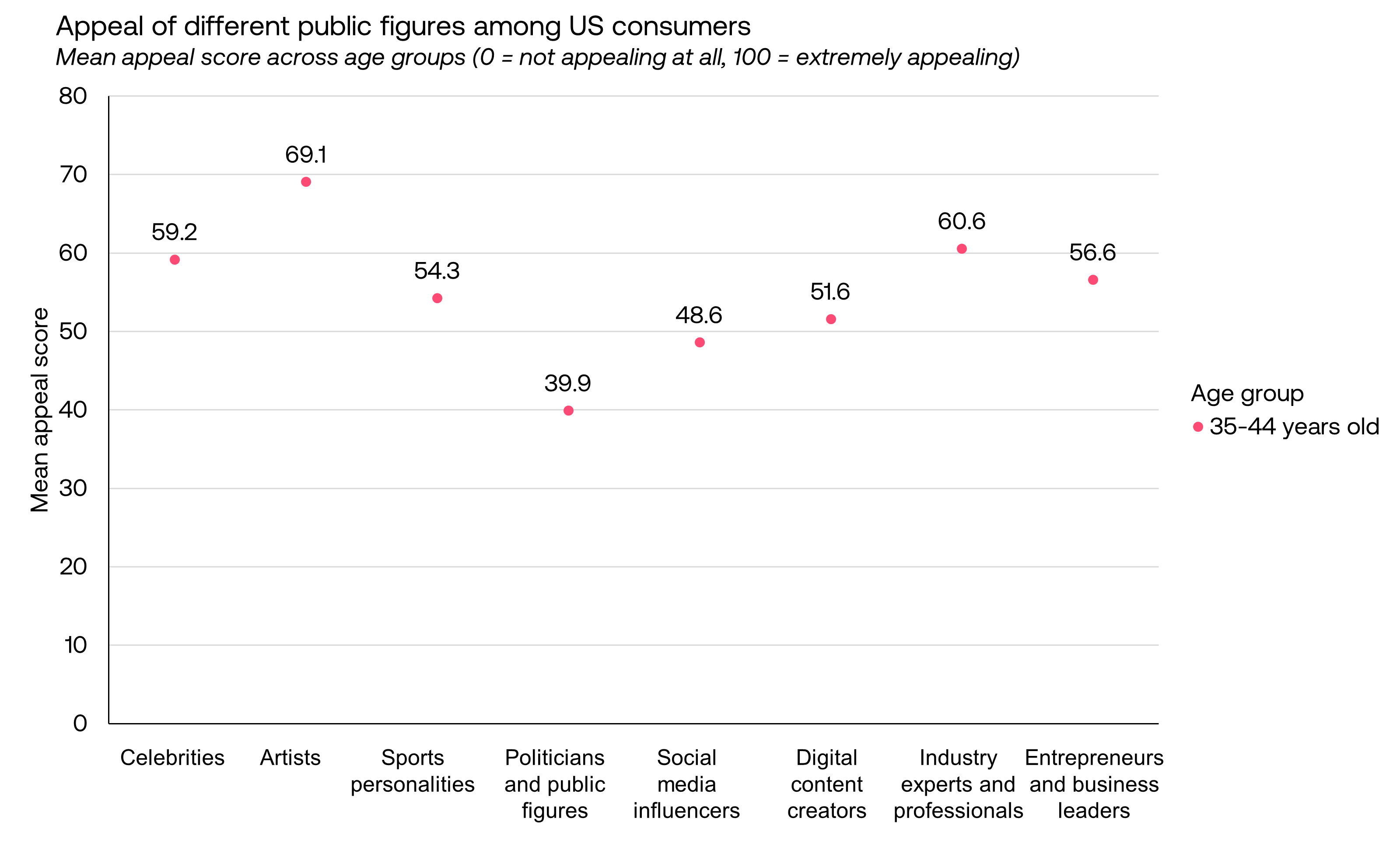
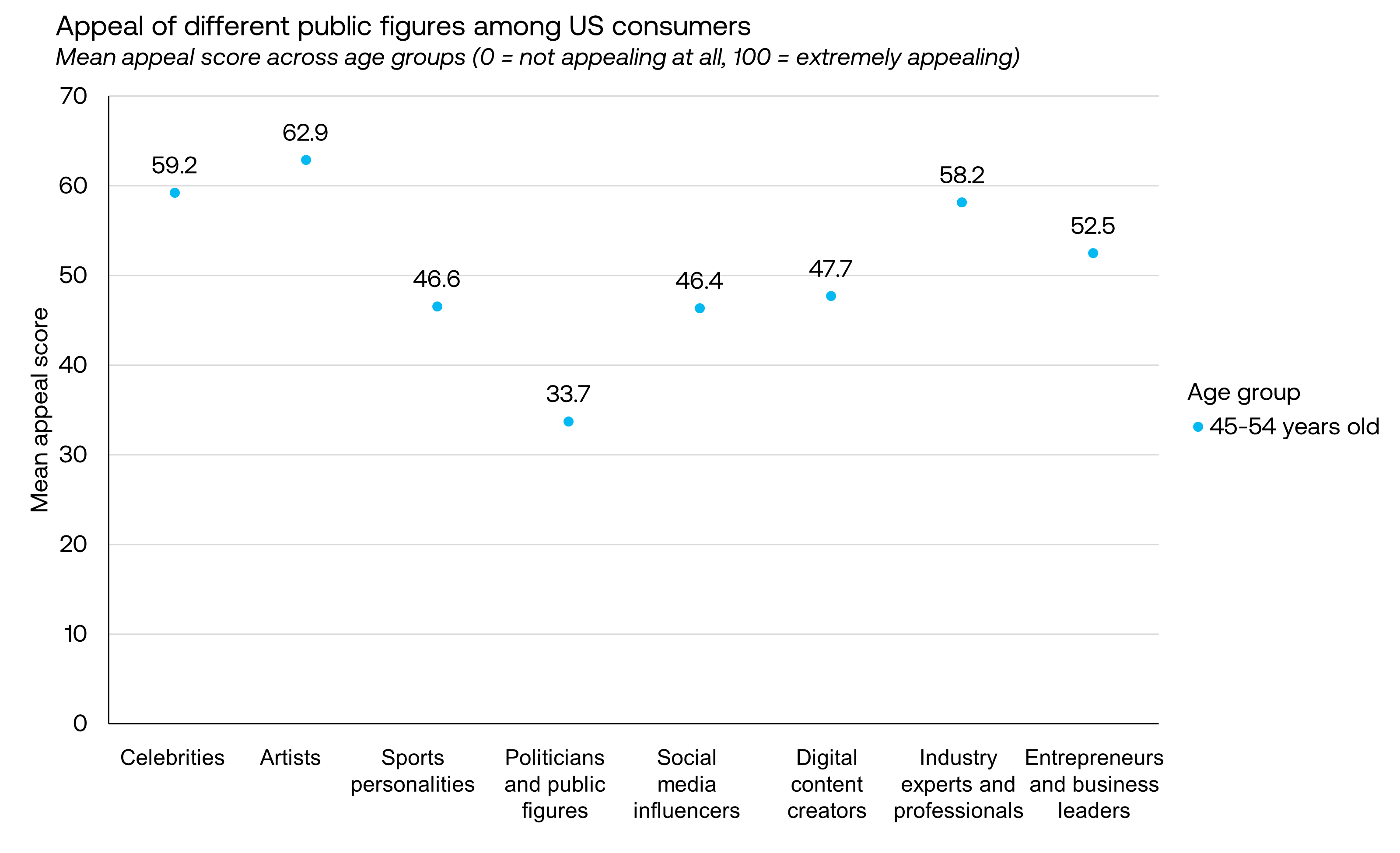
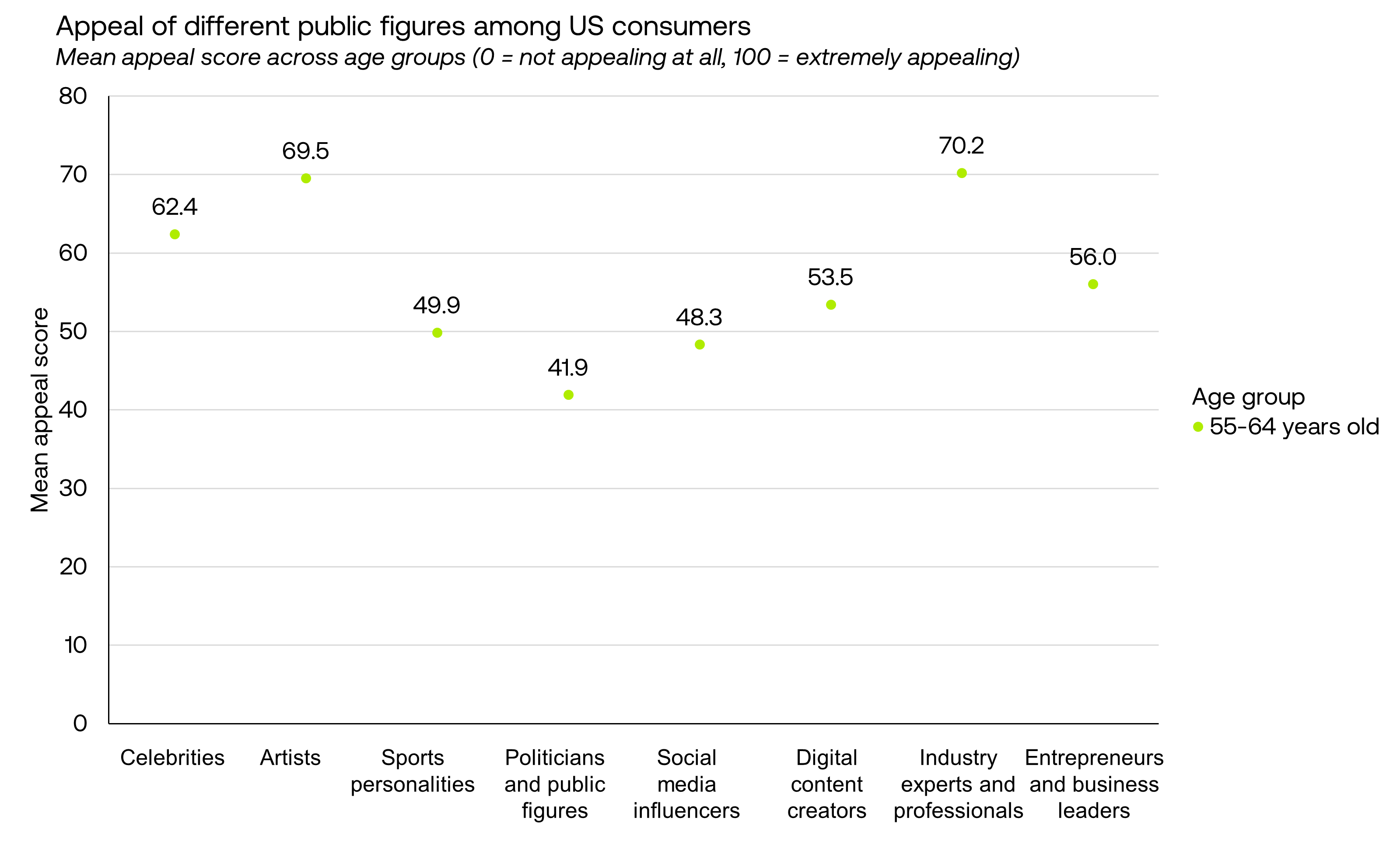
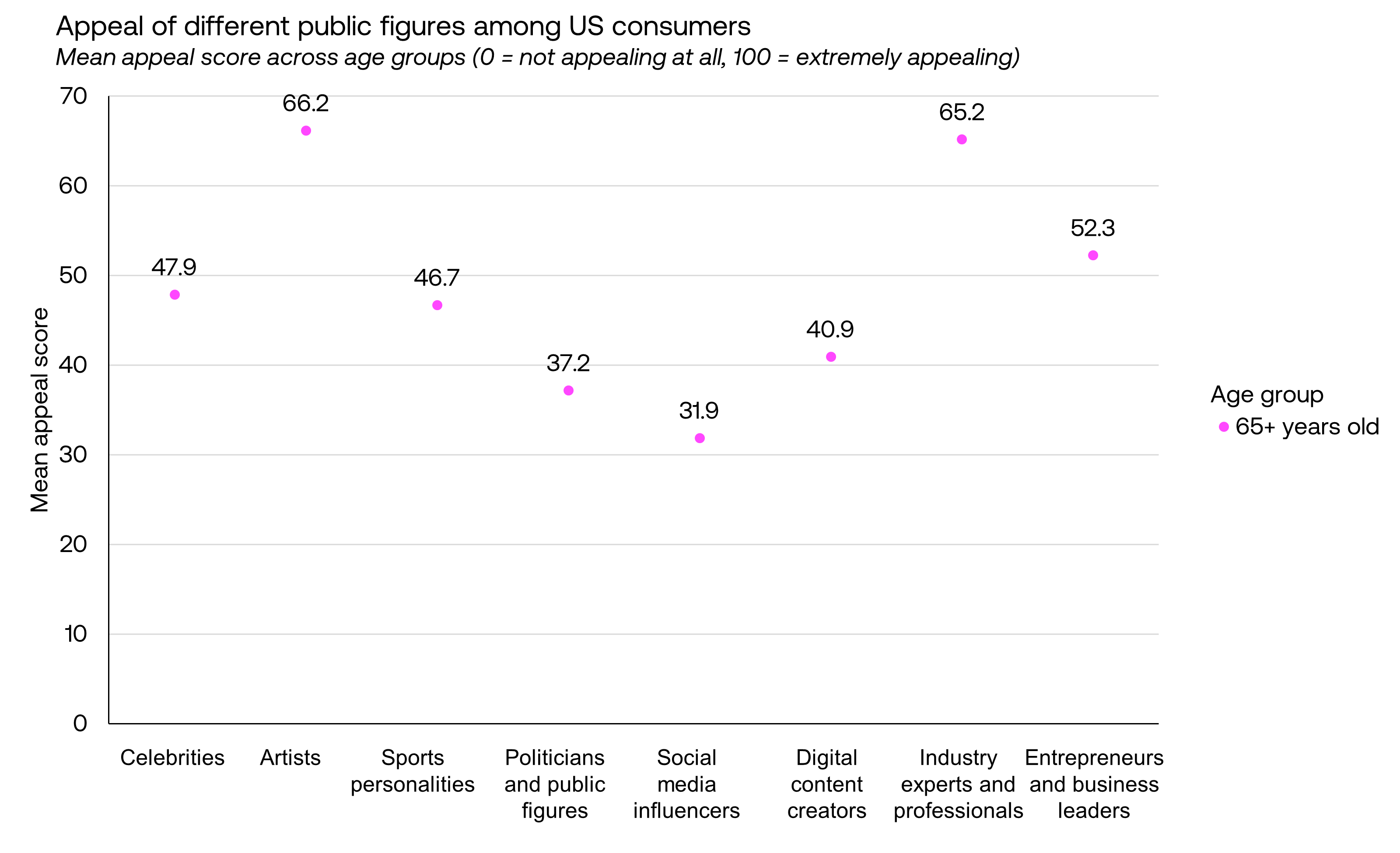
The data from our recent survey of 307 US consumers illustrates this clearly. Across all age groups, appeal scores vary meaningfully depending on the type of public figure.
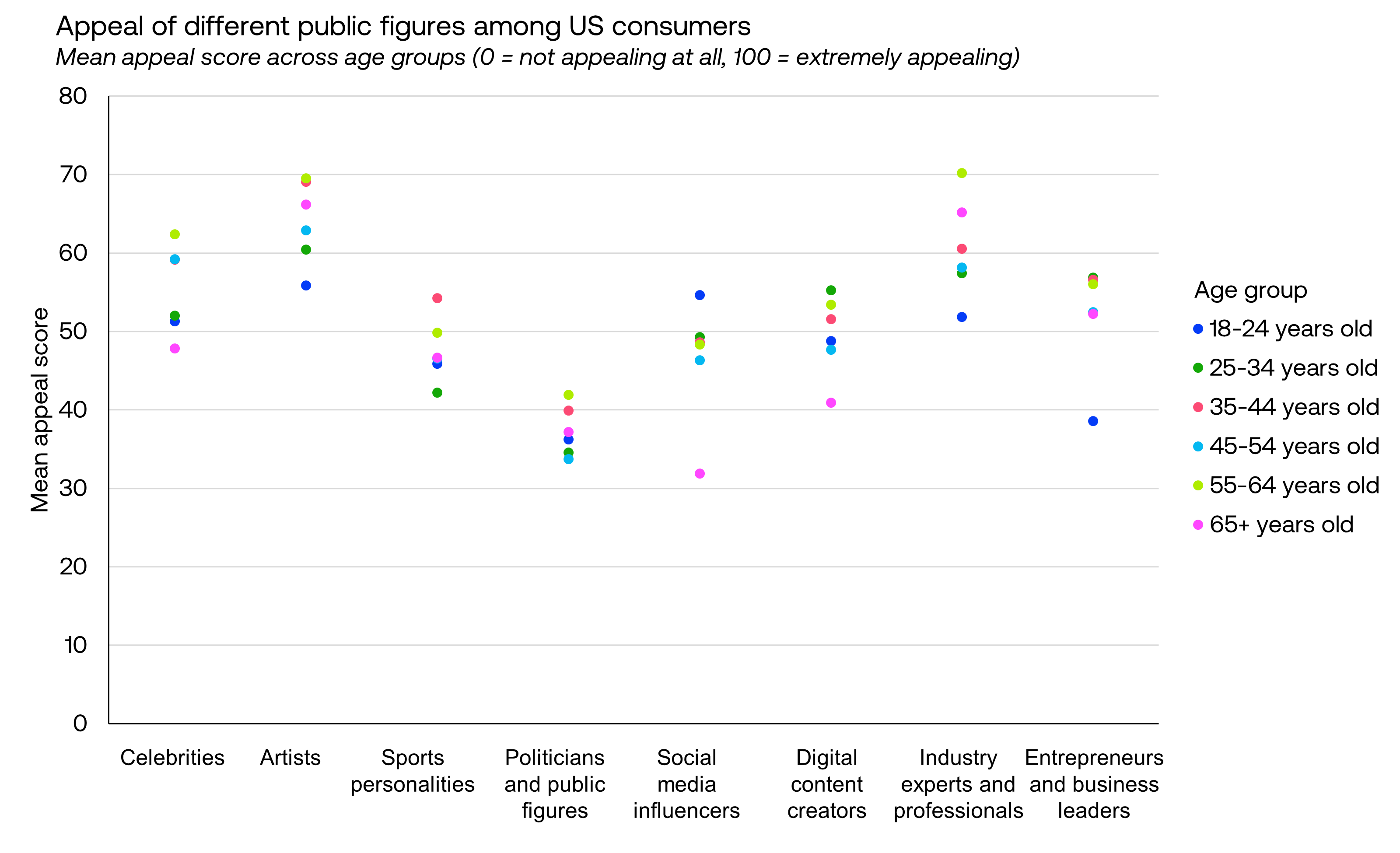
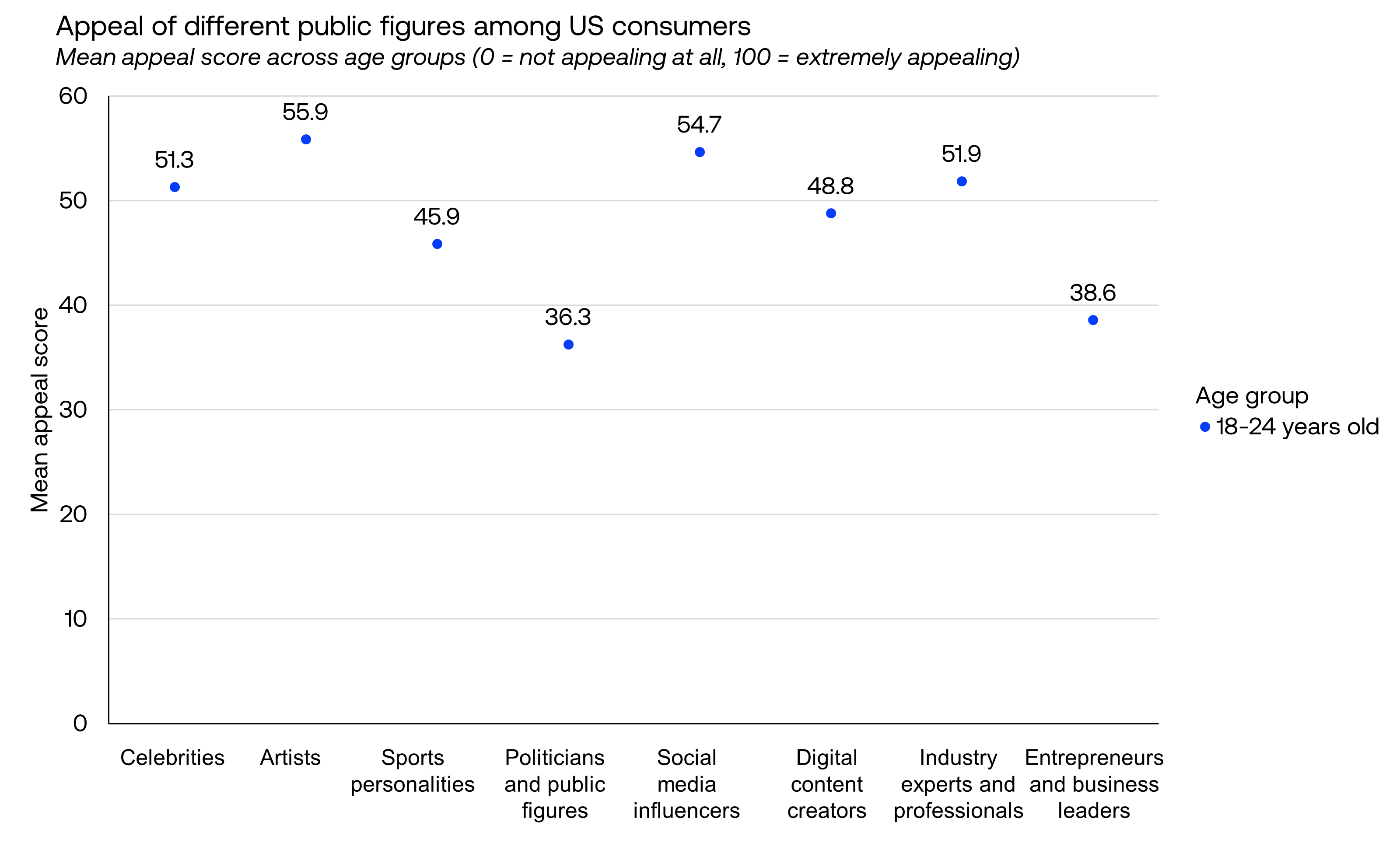
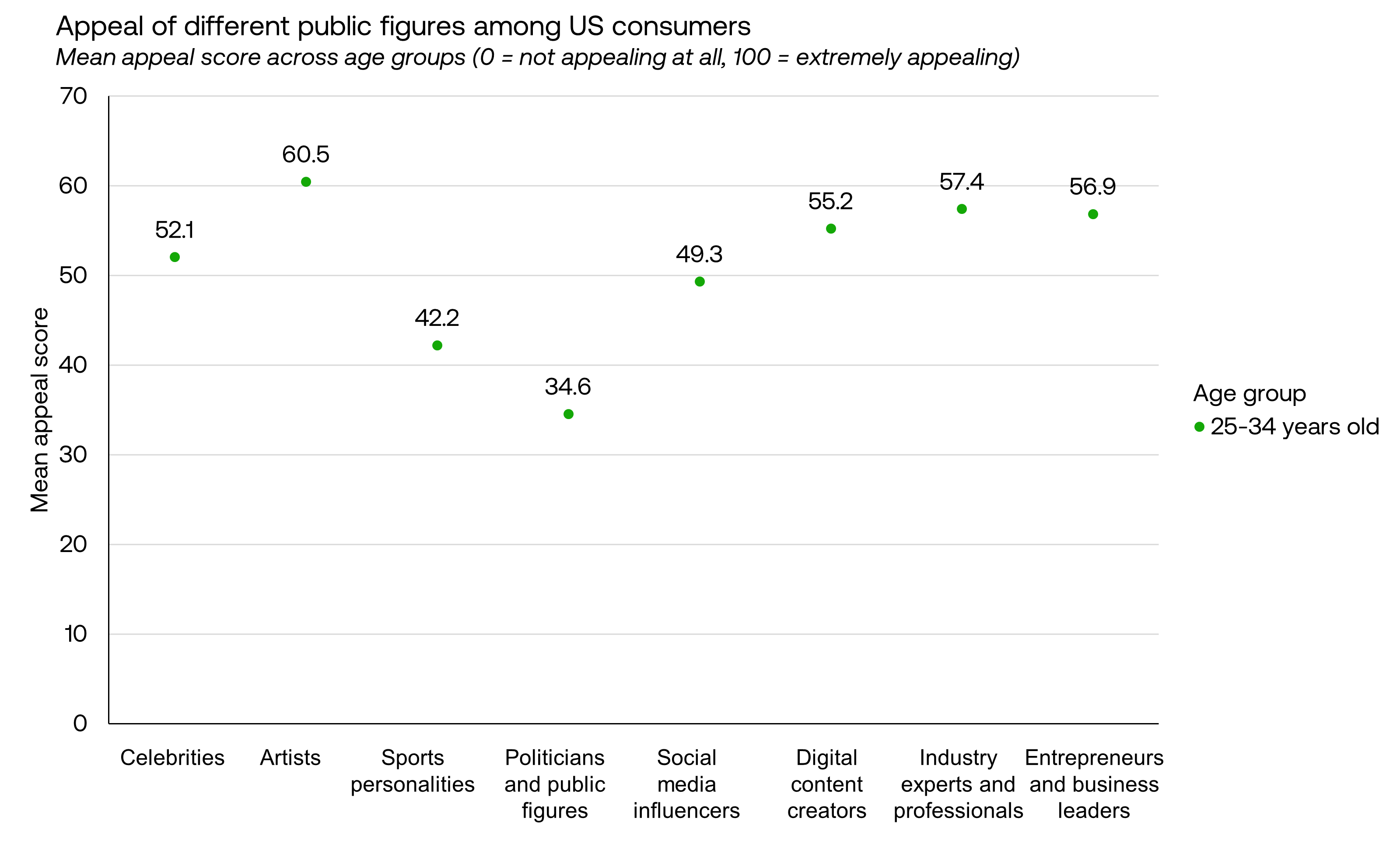
Older consumers (55 and above) give their highest appeal scores to industry experts, professionals, and artists. They respond to figures who project demonstrated authority or cultural prestige. For them, “attractive” means competent. Younger consumers tell a different story. Among 18-24 year olds, social media influencers and artists score highest, outperforming celebrities, industry experts, and entrepreneurs. This aligns with the psychology of homophily: younger audiences are drawn to people who feel like peers or cultural contemporaries, not polished, distant aspirational figures.
Pillar 2: Trustworthiness
Does the audience think the ambassador will tell the truth?
Trustworthiness measures the perceived honesty, integrity, and objectivity of a communicator. It asks one fundamental question: Does the audience believe this person actually means what they are saying, or do they have a hidden, self-serving agenda?
Trust has become one of the most critical yet often overlooked currencies in business. As the World Economic Forum observed in 2025: “When the world is full of disorientating white noise, people don’t look for more information. They look for a signal.”
According to Edelman’s 2026 Trust Barometer, a trusted influencer can even repair the reputation of a brand consumers distrust. However, trustworthiness is the most fragile pillar, and right now, we are seeing a widespread decline in how much people are actually willing to trust.
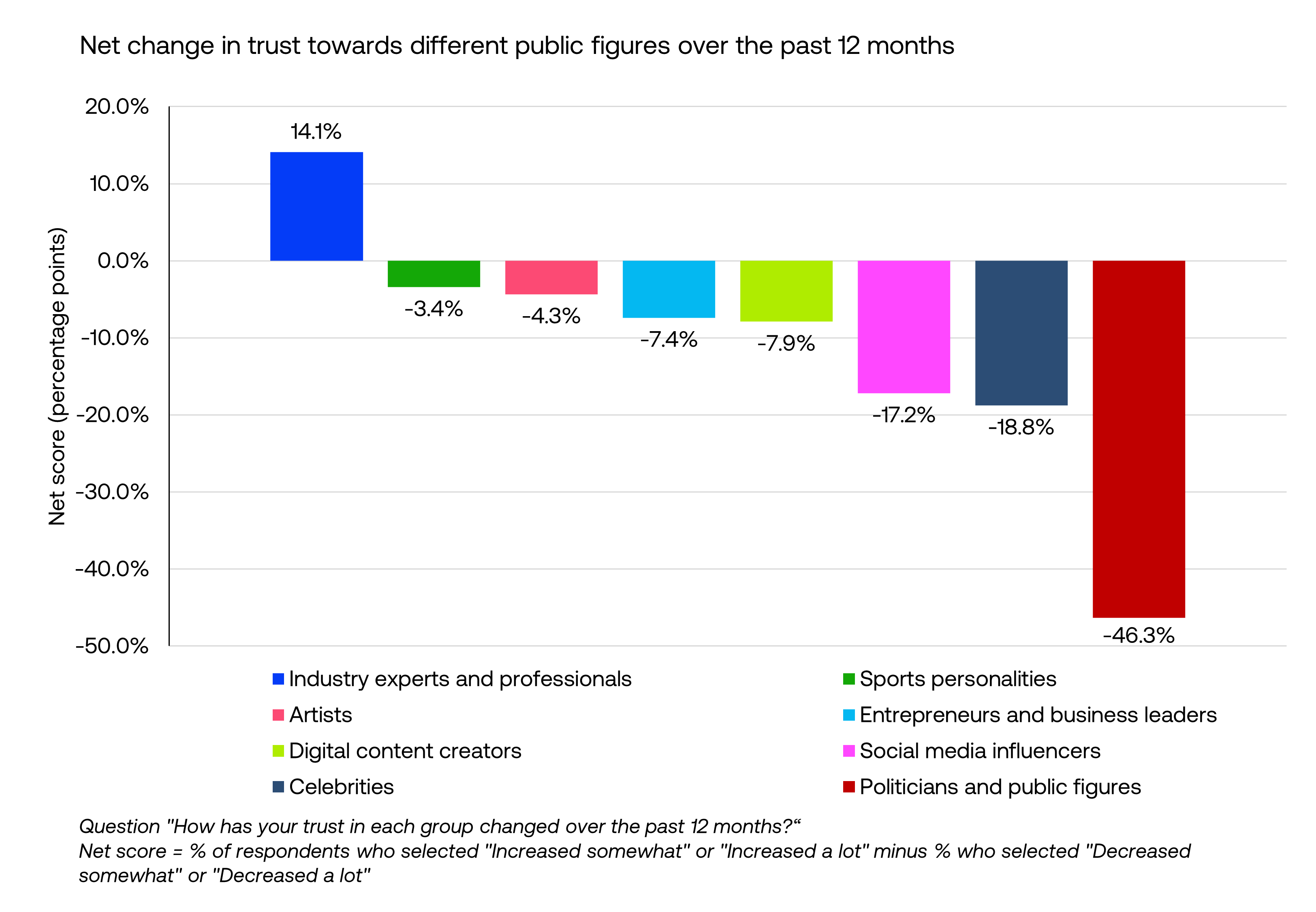
The net decline of trust
The data tells a clear story. Industry experts and professionals are the only group gaining trust in the past 12 months. Every other group is in decline, with politicians, celebrities, and social media influencers recording the steepest losses.
The 2025 Influencer Trust Index published by the US National Advertising Division (NAD) of BBB National Programs reported only 5% of consumers surveyed trust influencer content completely. And the three biggest trust killers are influencers who are not genuine or transparent, content that promotes unrealistic lifestyles, and failure to disclose brand relationships.
The cracks in this credibility are no longer subtle; they are front-page news. The spectacular collapse of FTX showed a roster of celebrities pushing complex financial products they lacked the expertise to evaluate, while Kim Kardashian’s $1.26 million SEC fine for promoting tokens without disclosure further corroded the entire marketing ecosystem. Influencers have faced wave after wave of regulatory action for undisclosed promotions. Each scandal individually is a PR disaster, but collectively they begin to justify why consumers are taking a more sceptical look at figures they once trusted.
Size vs. sincerity
Notably, the assumption that trust scales linearly with follower count turns out to be an oversimplification. Our data reveals a more nuanced pattern.
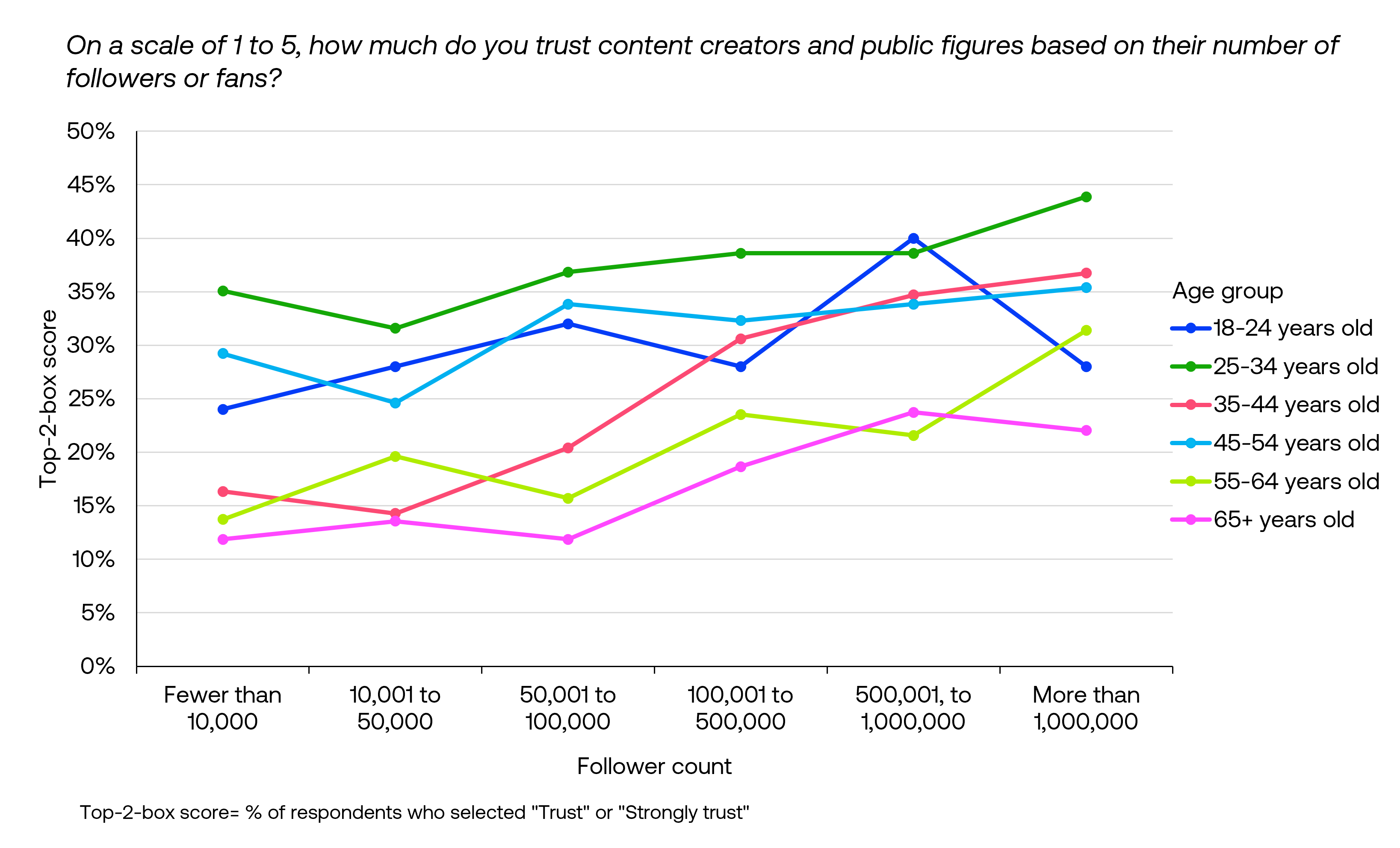
Across almost every follower tier and age demographic, trust levels remain remarkably low, with scores rarely exceeding the 40% mark on a top-2-box measure. This suggests that regardless of how many millions of people click “follow,” there is a persistent glass ceiling on how many actually believe the message being delivered. Older consumers are particularly unmoved by the numbers; those aged 65 and over remain sceptical throughout, with their trust levels starting at a mere 12% for smaller accounts and struggling to climb past 22% even as the follower count hits the millions.
The most striking insight from the data is the behaviour of the 18-24 year old demographic. While common marketing wisdom assumes this generation is the most receptive to large-scale creators, they actually display a sharp “trust cliff”. Their trust peaks significantly in the 500,000 to 1 million follower range, but then plummets to 28% once a creator passes the one-million-follower mark.
How platforms influence trust
Follower size is only part of the story; the platform itself dictates how much an audience is willing to believe, and currently, the landscape is shifting in contradictory directions.
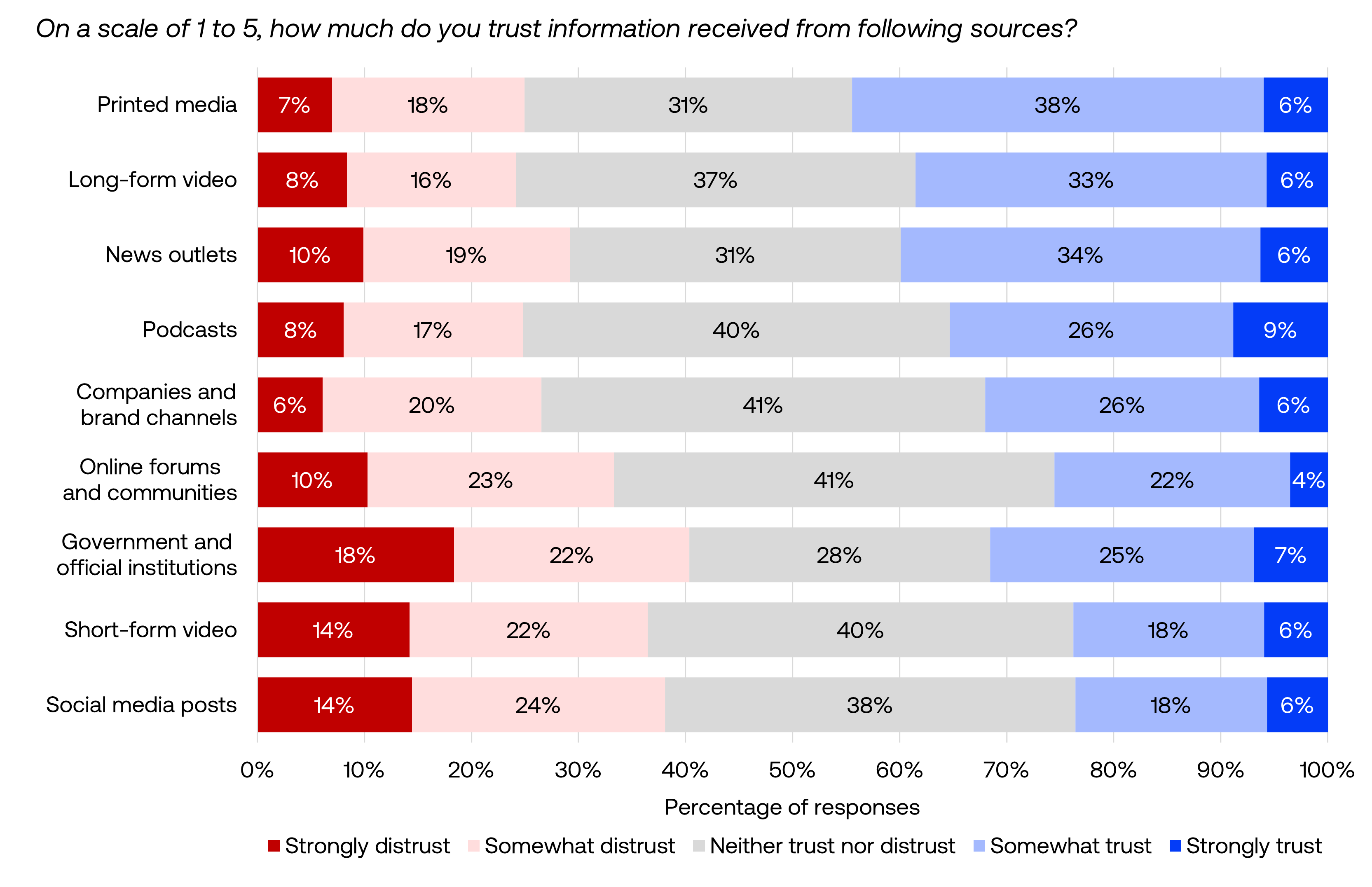
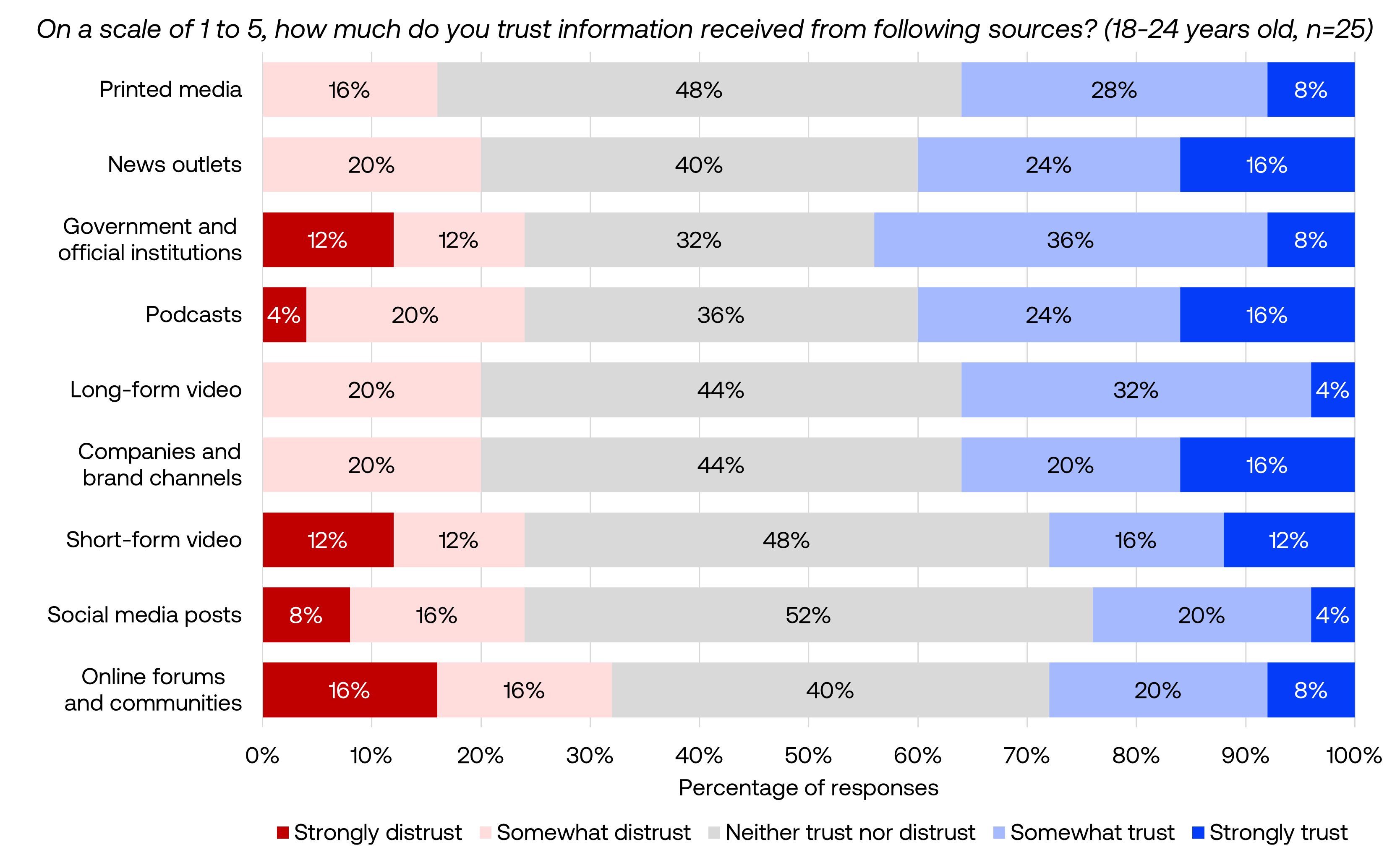
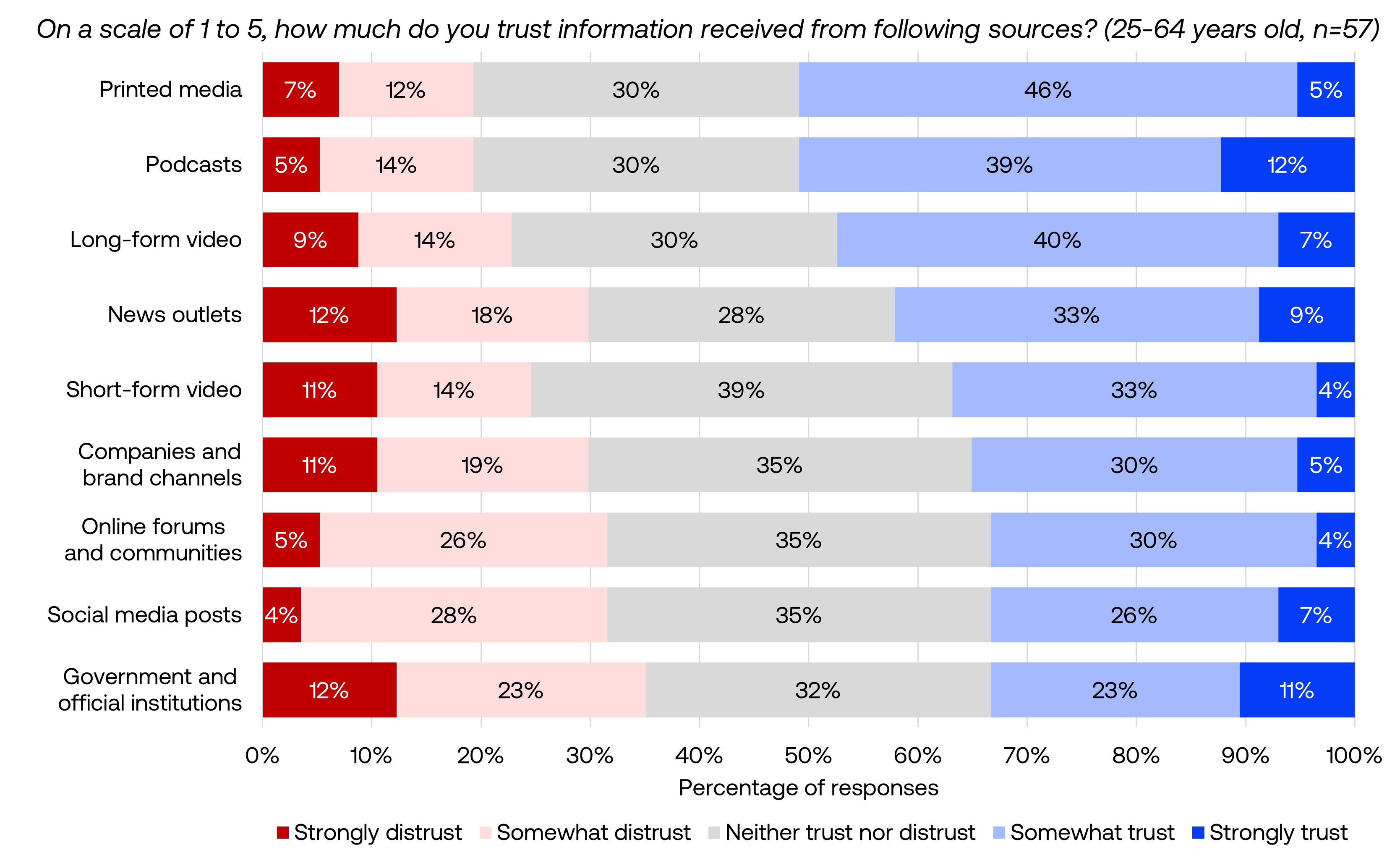
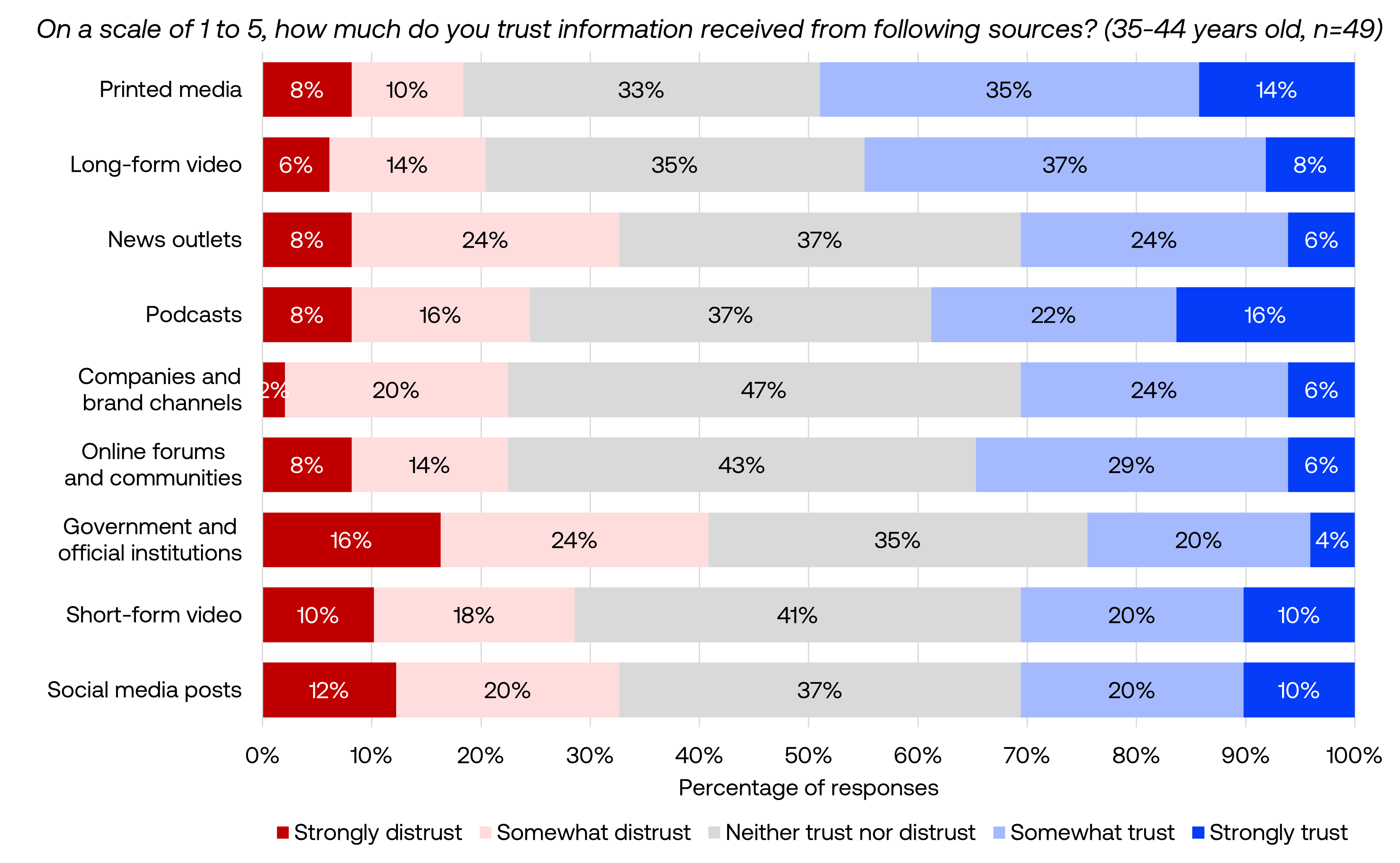
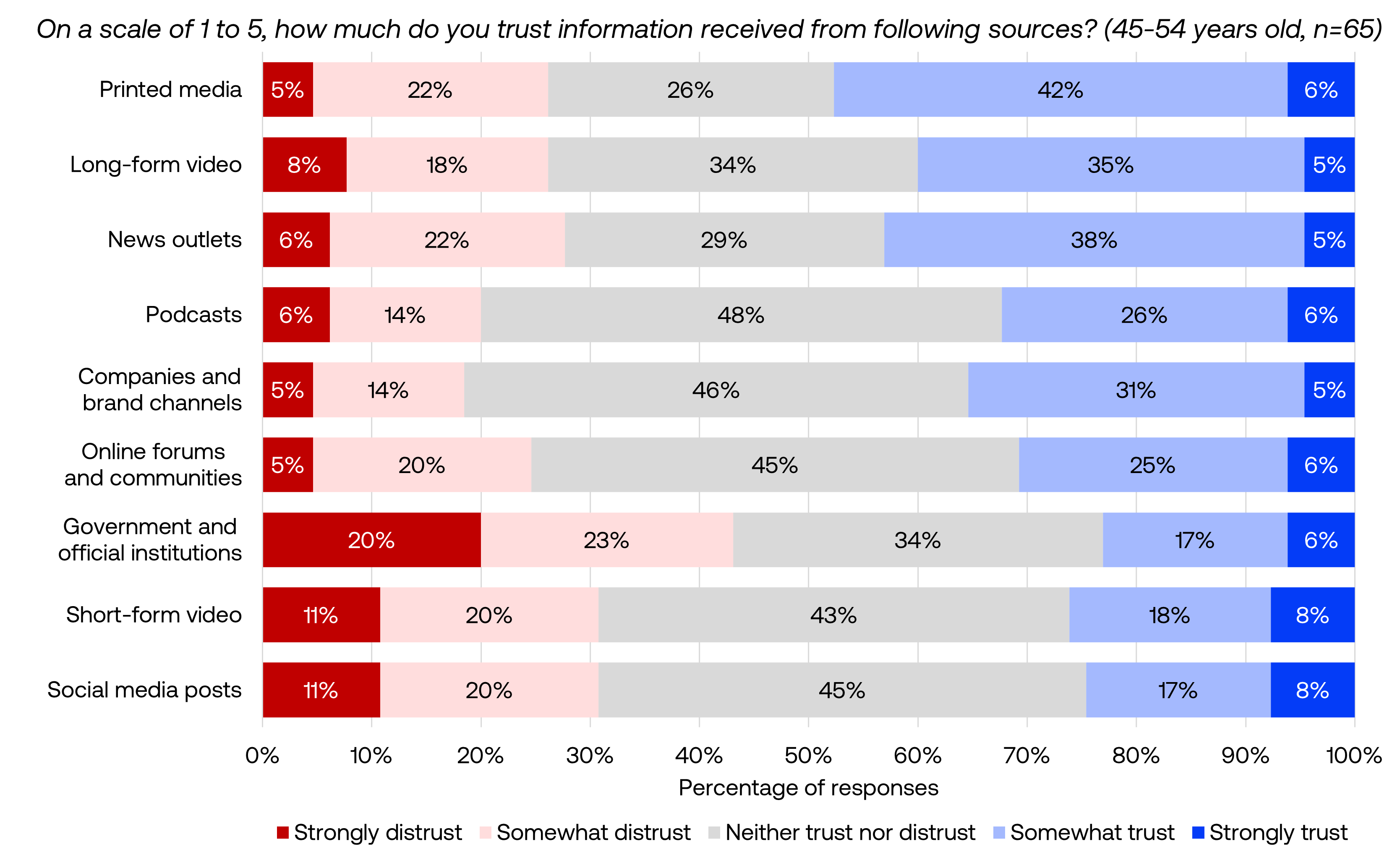
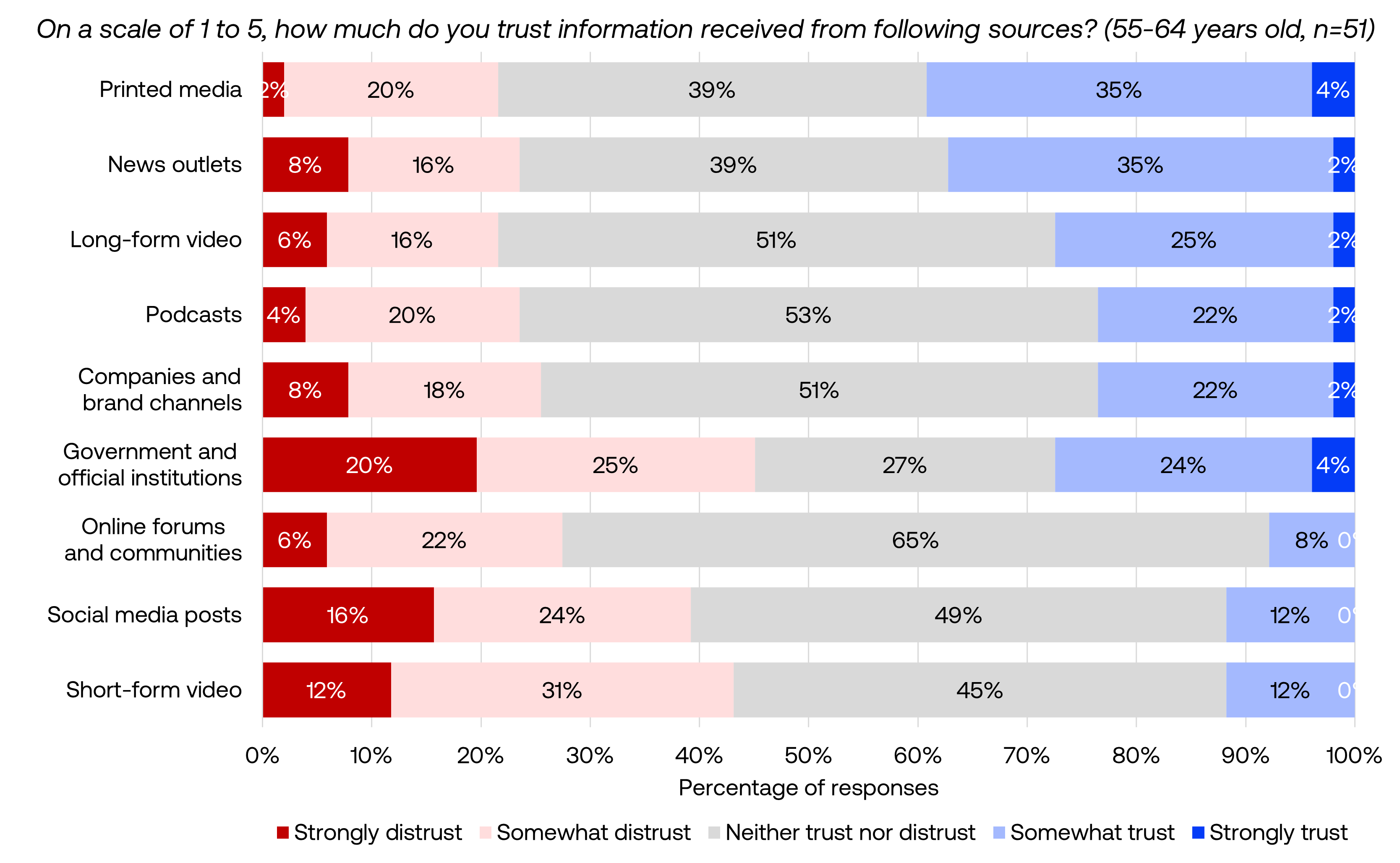
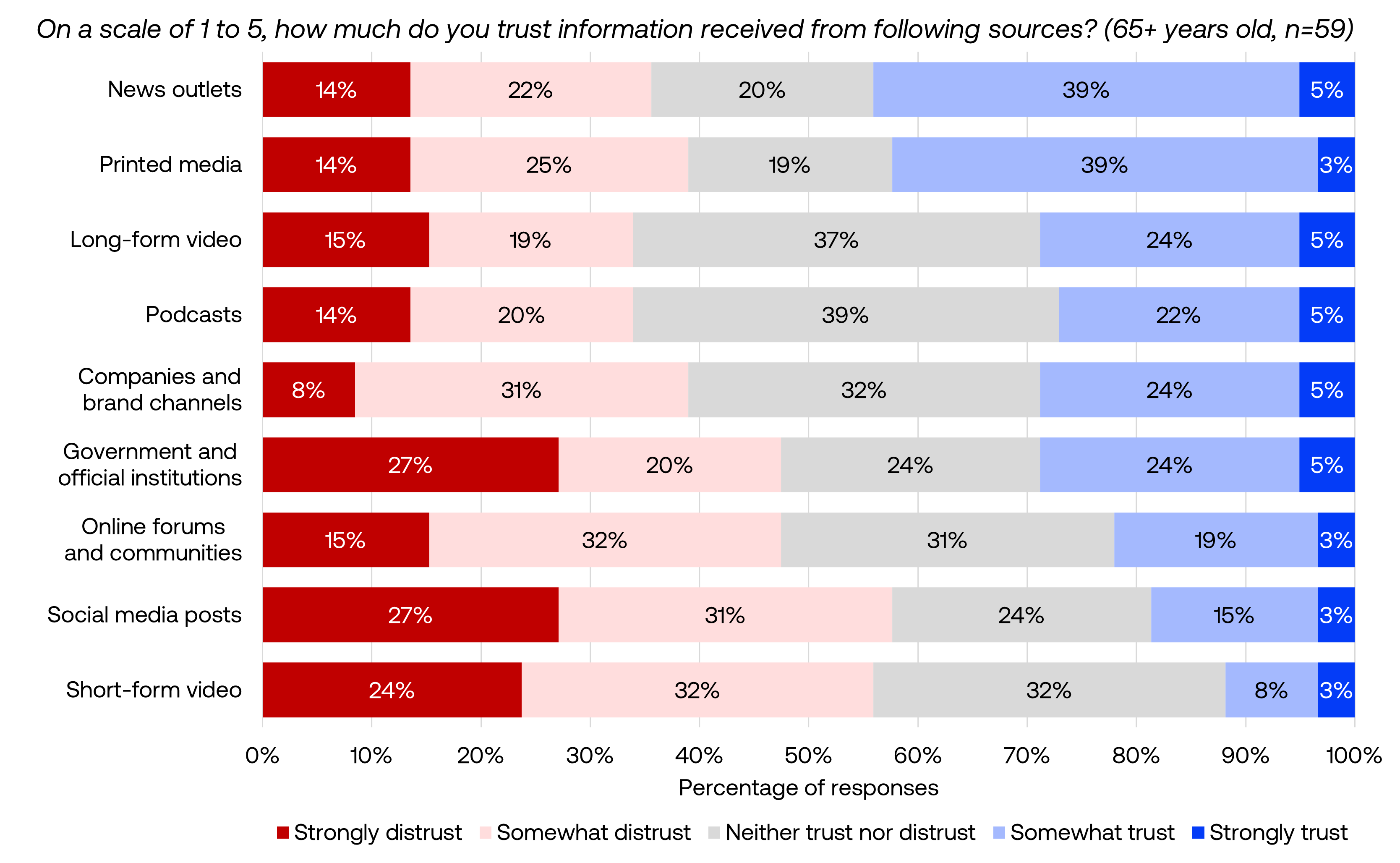
Printed media, long-form video, and news outlets lead on perceived trustworthiness, while social media posts and short-form video sit at the bottom. Reach and trust toward social media content are moving in opposite directions.
Breaking this down by age reveals that the platform trust hierarchy shifts markedly across generations. Social media posts and short-form video occupy a divided middle ground even among the younger generations. Respondents who trust them are roughly matched by those who distrust them. That balance tips increasingly negative with age. Podcasts and long-form video are the standout formats for broader reach without the trust penalty. Both peak among 25-34 year-olds and remain net positive through to 55-64, making them the most credible social-adjacent options across working-age Americans.
Printed media and news outlets are the only formats to maintain positive net trust scores across all age groups, reinforcing their role as the trust floor that other channels are measured against.
Pillar 3: Expertise
Does the audience think that the ambassador knows the truth?
Expertise provides the authority that gives a recommendation weight. It remains a neglected pillar because marketers often mistake reach for knowledge, assuming a large audience is a substitute for genuine subject-matter experience.
The influencer marketing platform CreatorIQ reported that in specialised categories, campaigns led by actual practitioners deliver three to four times higher engagement and significantly better conversion than those led by generic mega stars.
To explore this further, we asked consumers who frequently engage with content in a given area how likely they would be to consider products from various categories if recommended within that content area. For example, how likely are you to follow a fashion and style recommendation from a creator you follow for business and career content.
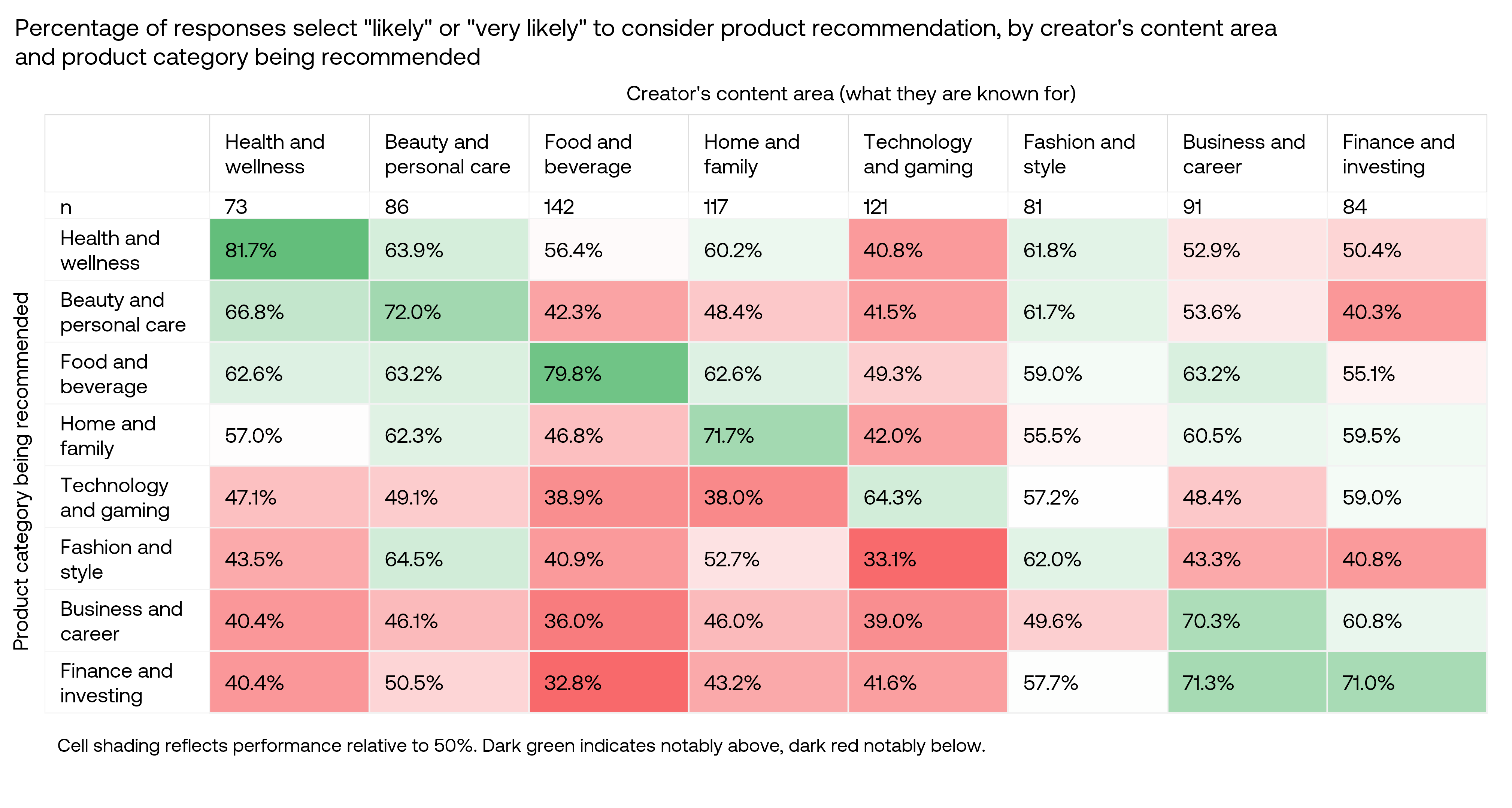
Audiences are most receptive to recommendations that stay within the content area the audience already engages with, i.e. health and wellness content recommending health products, finance creators recommending finance products. This pattern holds across all categories. Logically adjacent categories fare reasonably well too; beauty and personal care audiences remain open to health and wellness and fashion recommendations, reflecting the natural overlap between lifestyle-oriented content areas.
As the distance between content area and product category grows, consideration drops more sharply, particularly where the recommendation requires a distinct type of knowledge. Finance, technology, and business recommendations consistently underperform when surfaced outside their home content areas. On the other hand, food and beverage recommendations perform well with ambassadors from all types of domains. These findings highlight the importance of considering your own product’s domain when selecting an ambassador. For some industries, the most expensive mistake you can make is hiring a “personality” when you actually need a professional. If your ambassador does not have a track record in your specific category, they are just an expensive distraction.
Look at the Snoop Dogg and Solo Stove campaign of 2024 for an example. A high-profile name, a viral moment, and a CEO who lost his job because reach did not translate to sales. It turns out that we all love Snoop Dogg, but nobody looks to a rapper for fire pit engineering advice.
Three strategic personas
Pillar weights shift by industry, and success depends on aligning your choice with the consumer’s primary motivation. While every ambassador campaign involves a mixture of all three pillars, focusing on one initially can help clarify strategic ideas.
The Authority as ambassador
An expert who knows what they are talking about
The ambassador must be a personification of competence. In a B2B or tech context, this isn’t necessarily a celebrity; it’s more likely to be a thought leader, a renowned developer, or an industry-veteran CEO. If you use a traditional celebrity here, they must have a proven, authentic connection to the field. The audience is looking for an intellectual peer, so the ambassador’s primary job is to validate the product’s performance through their own professional reputation.
The Authority is typically considered the primary archetype of utilitarian products with a high financial or performance risk, like B2B software.
The Aspiration as ambassador
Who you want to be
The ambassador serves as a mirror for the consumer’s desires. Because these products are social symbols, the ambassador’s own likability and aesthetic “cool” factor are the most potent tools. This is where traditional celebrity endorsements and lifestyle influencers thrive. The goal is to trigger the Halo Effect: if the audience admires the ambassador’s lifestyle, that admiration is subconsciously transferred to the perfume or the fashion line they are wearing. Expertise is almost entirely replaced by “Vibe,” as the ambassador’s role is to make the brand feel socially relevant rather than technically superior.
The Aspiration is typically considered the primary archetype for hedonic products bought for social status, such as fashion or lifestyle brands.
The Guardian as ambassador
The one you trust
The choice of ambassador is a high-stakes decision centred on character and reliability. If you are selling baby food, healthcare, or financial security, the ambassador must be someone the audience views as a “safe” bet - someone with a clean public record and a relatable, nurturing, or protective public persona. Parents don’t want a “high-fashion” ambassador for baby formula; they want someone who appears to share their own protective instincts. The ambassador’s role is to act as a guarantor of the brand’s promises, bridging the gap between a faceless corporation and a concerned parent.
The Guardian is typically considered the primary archetype for high-stakes categories centred on safety and reliability, like healthcare.
Does fame only sell us on what we already know?
Ambassadors rarely create trust from scratch; they trigger what is already there. Across most demographics, the primary reason consumers act on a recommendation is a pre-existing relationship with the brand - brand familiarity is a leading conversion driver for 25-34 year olds (47%), 45-54 year olds (46%), 55-64 year olds (53%), and 65+ (51%).
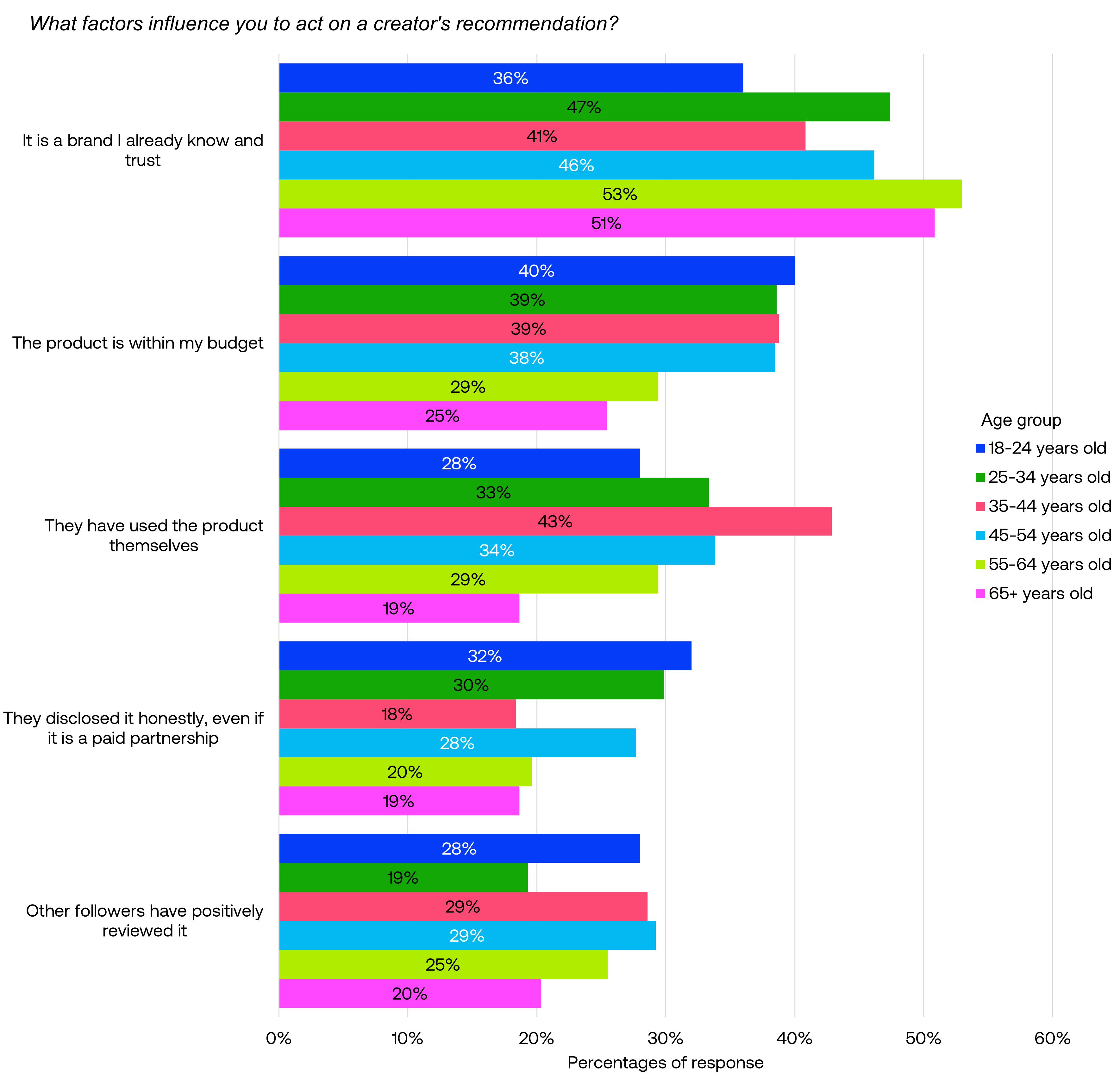
This suggests that ambassadors may actually be most effective for established, “household name” brands rather than newcomers. For these companies, the ambassador functions less as a source of introduction and more as a tool for staying top of mind. They act as a “guarantor,” bridging the gap between a faceless corporation and the consumer by validating a brand the audience is already comfortable with. In this context, the ambassador’s role is to reinforce existing brand equity and ensure the company remains socially relevant within the consumer’s daily feed.
The research framework
If this article can convince you of one thing, I hope it is this: brand ambassador selection should be the final result of your audience research, not the starting point for it. Because different influencers mean different things to different groups, you cannot rely on ‘vibes’ to bridge the gap between your product and your consumer. To move from guesswork to a data-driven diagnosis, we suggest a multiple-stage research process.
Stage 0: The Audience Baseline
We call this Stage 0 because this is something (we hope) you already know: you need to understand your audience and exactly who you are trying to reach with this partnership.
- RQ0: Who are we actually talking to?
The goal here is to define what they find authoritative, expert, or attractive. This is about identifying the data points that challenge any preconceived notions your marketing team might already have. Unless you know what your customer actually values, you’re just choosing an ambassador who appeals to your own office.
Stage 1: The Diagnostic Pillar
Once the audience is defined, you must determine which pillar of Social Credibility Theory will carry the most weight for your category. This involves answering three critical questions:
- RQ1: Which pillar (Expertise, Trust, or Attractiveness?) is most essential for an ambassador in your category?
- RQ2: Which specific domains of expertise do your customers respect, and are they open to endorsements from creators outside your immediate category?
- RQ3: On what mediums do your customers actually find information trustworthy?
The goal of this stage is to establish clear strategic guardrails. By answering these three questions, you define the necessary archetype, the professional domain the person should come from, and the specific channels where the message will actually be believed.
Stage 2: The Persona Audit
Data can tell you that you need an “Authority” or a “Guardian,” but it cannot fully account for human nuance. At this stage, you must move beyond your own internal assumptions and ask your potential customers directly who they believe fits the criteria you’ve established.
- RQ4: Who fits the specific requirements found in Stage 1?
People are not formulas; even if three candidates have similar levels of fame, their cultural weight differs significantly. Nicolas Cage, Denzel Washington, and Leonardo DiCaprio are all award-winning, successful actors, but the values they represent to an audience are worlds apart. Your research must determine which candidate’s “brand” in the eyes of the consumer genuinely overlaps with your product. Don’t decide for them, let their feedback dictate who has the right cultural fit.
Stage 3+: Continual evaluation
Ambassador perception is not a “set and forget” metric. Humans are fluid, and our perception of them is constantly shifting based on cultural trends and personal scandals. Stage 3 is a continual commitment to answering the question:
- RQ5: Does this ambassador still represent our brand’s values?
By continually tracking the perception of both your ambassador and your brand, you can ensure that your “Authority” hasn’t lost their credibility, your “Aspiration” hasn’t lost their charm, or that your “Guardian” hasn’t become a liability.
Moving from guesswork to diagnosis
Marketing is currently navigating a significant identity crisis as brands struggle to find authentic ways to connect with consumers in an era of AI and uncertainty. While the theory of using a recognisable face to move consumer behaviour is sound, millions of dollars are wasted annually on partnerships that rely on “vibes” rather than data-driven strategy.
Finding the right ambassador is undeniably hard, but that doesn’t mean it should be avoided, it just means it should be the result of audience research, not the starting point for it.
If you’re ready to stop relying on guesswork and start using a data-driven diagnosis to find your ideal brand ambassador, we can help.