
Ray-Ban Meta glasses were dubbed 'pervert glasses' amid growing privacy concerns in 2026. Will real consumers pass on the product? We ran a concept test to find out.
In 2026, social media feeds erupted with complaints about people using Ray-Ban Meta glasses to secretly film strangers. Viral videos and press reports quickly dubbed the device “pervert glasses.”
The backlash escalated as Instagram promised to remove harassing videos recorded with the glasses, alongside a concurrent wave of lawsuits and criminal probes into covert filming.
🇫🇷 Smart glasses have a serious privacy problem in Paris
— Mario Nawfal (@MarioNawfal) September 19, 2026
Paris prosecutors have opened a criminal probe into suspected sexual harassment involving the devices after authorities received complaints from businesses.
The uncomfortable question is getting harder to ignore: when a…
Meta's AI glasses accused in California lawsuit of secretly capturing sex, nudity and bathroom footage https://t.co/lKcVBbYVbJ pic.twitter.com/Y0dGHF9eZt
— New York Post (@nypost) September 19, 2026
Judging from Twitter threads and news headlines, a product this widely condemned should be a much harder sell today. To see if that held true, Conjointly ran a product concept test on the Ray-Ban Meta glasses in September 2026. The study reused the exact metrics from a previous study in October 2024 to compare the results across both cohorts.
Here is what the data actually showed, and what brand leaders and managers can take away for their own offerings.
The results at a glance
Consumers’ purchase intent barely moved
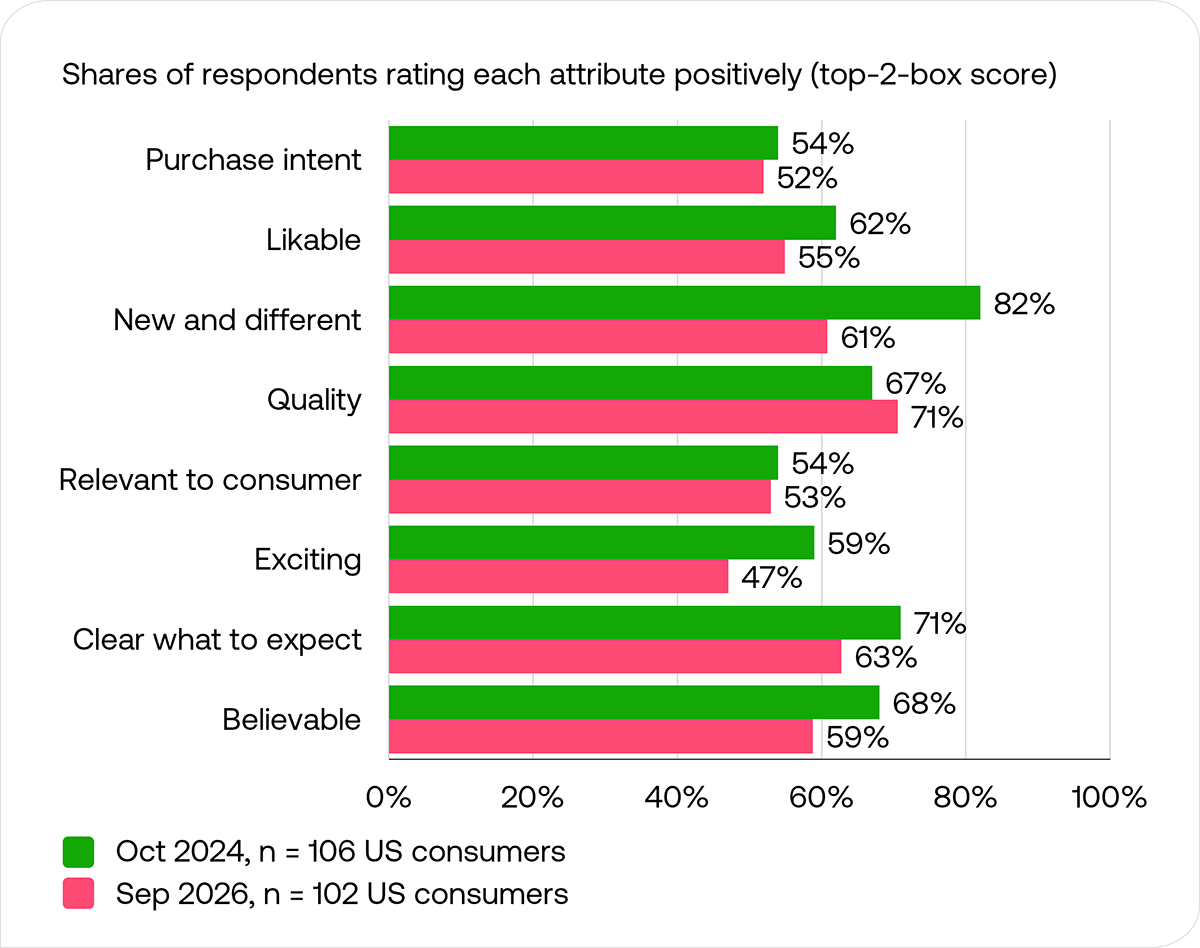
In 2026, 52% of respondents indicated intent to buy, remaining statistically flat compared to 54% in 2024. Even more telling, consumer price acceptance shifted upward from USD $62–$117 in 2024 to USD $100.50–$194.50 in 2026, moving closer to the product’s $299 retail price.
The widespread privacy controversy might have been expected to crush demand, but the data showed otherwise. Though not directly evaluated in the study, this underscores a common market reality: the loudest online voices do not necessarily represent broader consumer sentiment.
Product perceptions shifted as the product matured
What did change was how consumers perceive the product:
- “New and Different” scores tumbled from 82% to 61%.
- “Excitement” dipped from 59% to 47%.
- Overall likeability cooled slightly from 62% to 55%.
- Perceived quality actually increased from 67% to 71%.
After a product has been on the market for a few years, novelty naturally wears off, and useful features and clear value typically need to fill that gap to keep consumers engaged. This is why brands should regularly evaluate mature products with target consumers to yield the insights required to refresh messaging, highlight core value, and ship relevant updates before interest fades.
Privacy concerns spiked but remain a minority view
When asked generally about what they disliked, respondents barely mentioned privacy in 2024. By 2026, the number of respondents citing privacy concerns had increased noticeably.
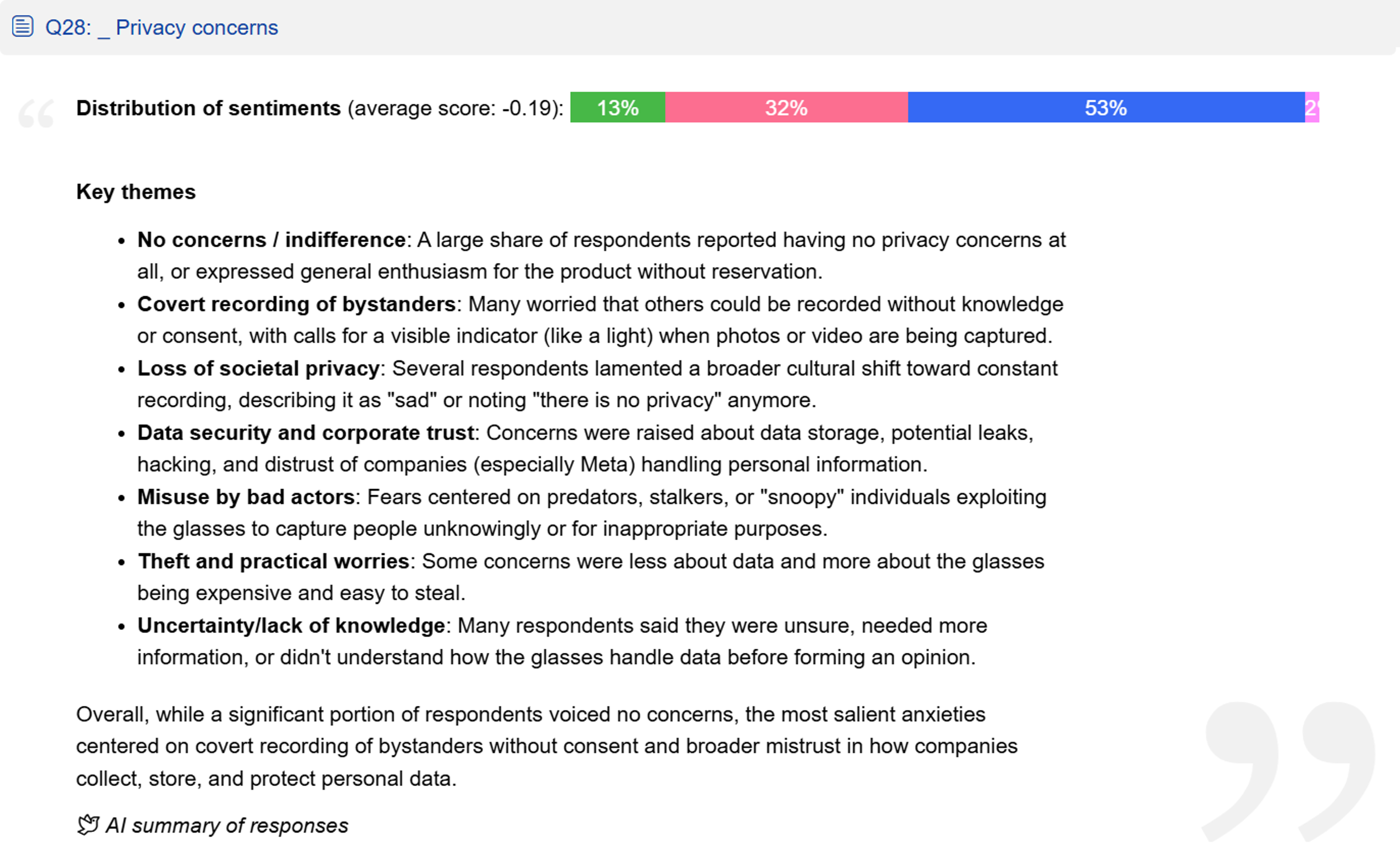
Interestingly, when asked directly about their privacy concerns, the vast majority expressed no concern. Only a small minority raised strong concerns, concentrated on three main risks: covert recording, Meta’s data handling, and predator misuse.
Overall, privacy concerns have become far more prominent in public discourse, but they remain a deal-breaker for only a fraction of general consumers.
Make product decisions based on real consumer insights
While recent negative coverage suggests that Ray-Ban Meta glasses occupy a very different market position today, actual consumer purchase intent remains virtually unchanged since 2024.
Social media algorithms thrive on outrage, making vocal criticism appear universal. However, as this study demonstrates, high-profile online backlashes do not always lead to changes in consumer behaviour.
This is where consumer research proves its value by giving teams the empirical evidence needed to distinguish vocal backlash from actual consumer decisions, ensuring strategic choices are driven by data rather than noise.
Ready to see how real consumers perceive your product concept?