
Conjointly offers several ways to run qualitative research, from conversational surveys and video responses to open-ended questions, so you can match the method to the depth of insight you need.
Whether you need additional context for your metrics or want to uncover the true story behind consumer choices, Conjointly brings qualitative research directly into your workflow. From conversational surveys and video responses to a wide range of open-ended questions, you can deploy these tools as standalone qualitative studies or combine them seamlessly with existing surveys.
Interview respondents using adaptive conversational surveys
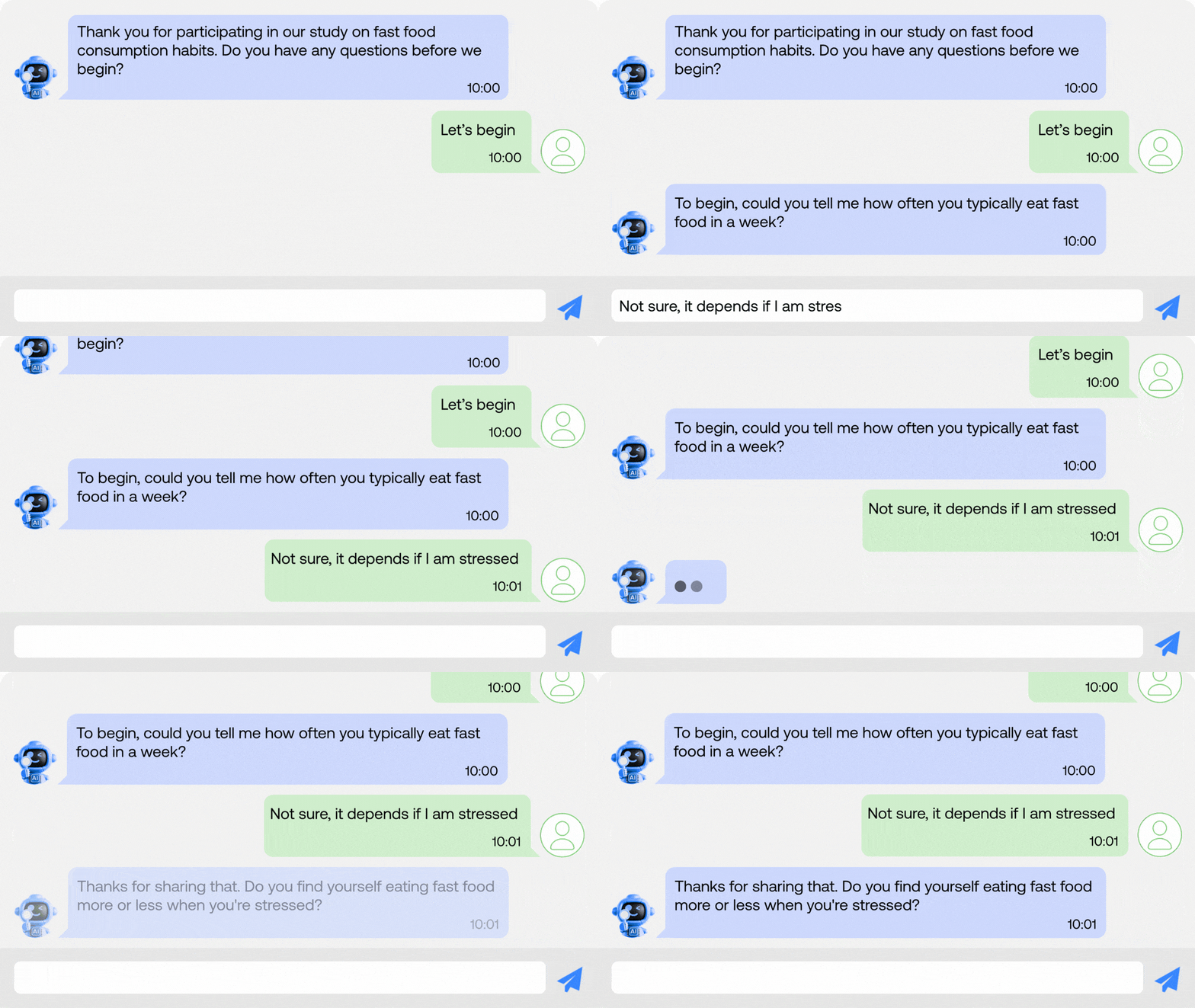
Conversational surveys bridge the gap between static surveys and personal interviews. Instead of marching down a fixed question list, the survey analyses each answer in real time and asks targeted, relevant follow-ups, the same way a trained interviewer would.
In a typical open-ended survey, a question like “How was your experience?” often gets brief answers like “It was fine.” A conversational survey automatically probes deeper, asking what was fine, why, or compared to what, turning surface-level feedback into actionable insight.
A side-by-side test showed 53% of conversational survey answers ran past 100 words, against just 5% for the same question asked as static text.
In a separate study on ride-sharing habits, 71% of satisfied users revealed hidden frustrations when the automated follow-up probed deeper.
With minimal set-up required, conversational surveys let you capture interview-level depth across hundreds of global respondents simultaneously, whenever your project demands it.
Let respondents show you with video responses
Video responses capture self-recorded video answers from your target audience, making them ideal when you need respondents to demonstrate an action or describe an experience on camera rather than through typed text.
This approach captures non-verbal cues, authentic tone, and real-world reactions without the scheduling bottlenecks of live interviews. It is ideal for unboxing experiences, remote usability testing, or gathering vivid customer testimonials at scale. Seeing and hearing respondents on camera also serves as an added layer of quality assurance, ensuring every answer comes from a real, engaged human.
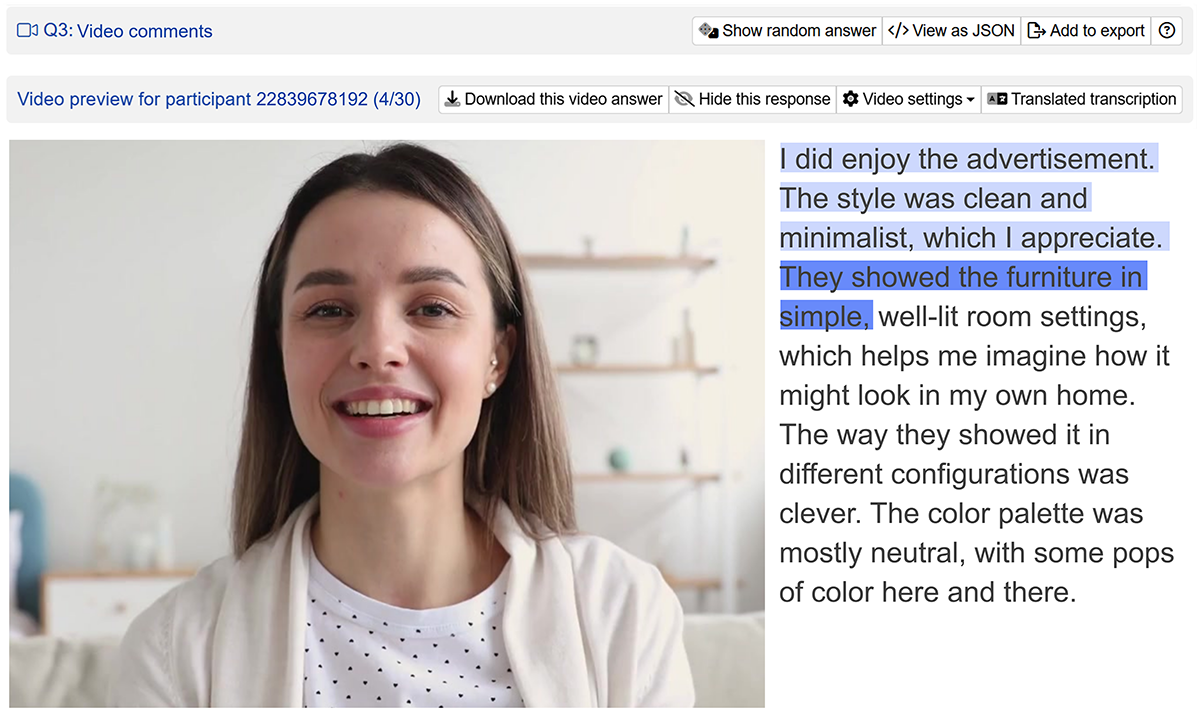
Every video response includes automated transcription and translation. You can search, code, and analyse video clips directly inside your reporting dashboard with no manual transcribing needed.
Add qualitative depth to any survey with specialised open-ended question types
You don’t always need a separate, standalone study to capture rich qualitative context. Conjointly offers a wide range of open-ended questions you can place inside any survey, allowing you to capture the stories and motivations behind your metrics in a single project. Here are four widely used examples you can drop into any survey:
Image heatmap questions
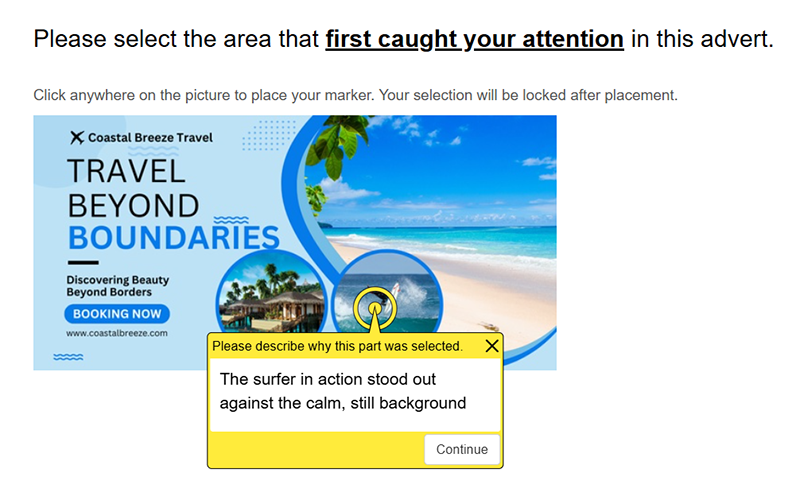
Image heatmap questions ask respondents to click directly on specific areas of an image and leave a comment explaining their choice. This makes them ideal for pinpointing which visual elements in a pack design, ad creative, or concept sketch draw attention or trigger confusion.
Text highlighter questions
Text highlighter questions let respondents highlight specific words or phrases in a block of text and attach direct feedback. You can test messaging, evaluate copy clarity, or instantly identify confusing terminology in product descriptions and instructions.
Positive/negative open-ended questions
Positive/negative open-ended questions split likes from dislikes into two distinct fields upfront. Separating sentiment at the point of response prevents mixed feedback and delivers clear, structured qualitative data that is much easier to analyse.
Short text and paragraph inputs
Short text and paragraph input questions give respondents an open text box when a single line or two is all you need. They offer a fast, flexible way to capture spontaneous reactions, brand associations, or brief explanations behind specific numerical scores.
Turn qualitative data into insight automatically
Collecting hundreds of open-ended answers, conversational transcripts, and video clips is the easy part. Making sense of them at scale is the real challenge. Conjointly does all the heavy lifting with automated, AI-driven analysis built directly into your reporting dashboard.
Automated AI summaries and sentiment analysis give you an instant overview of the key themes and sentiment across open-ended feedback. This saves hours of manual reading and coding, allowing you to identify core insights the moment data collection completes.
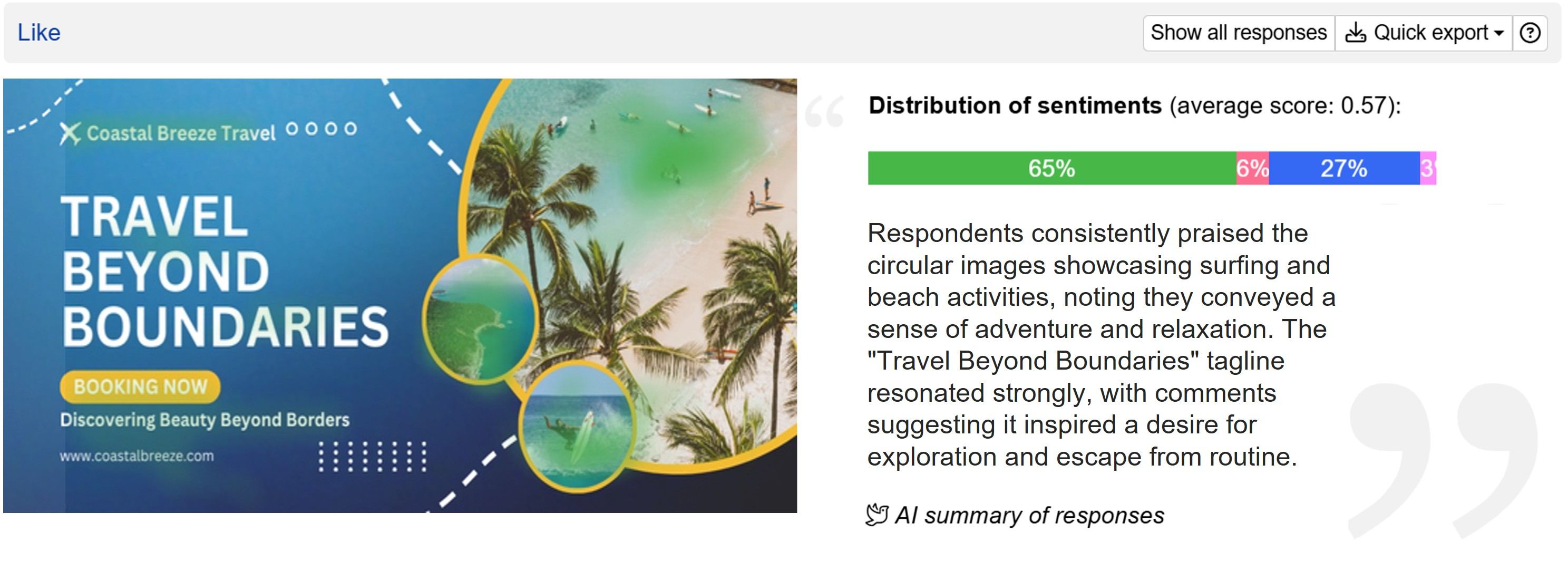
Conversational surveys and video responses take this further: every response comes with automated transcription and translation into English built in, so multilingual and video data are just as easy to analyse as plain text.
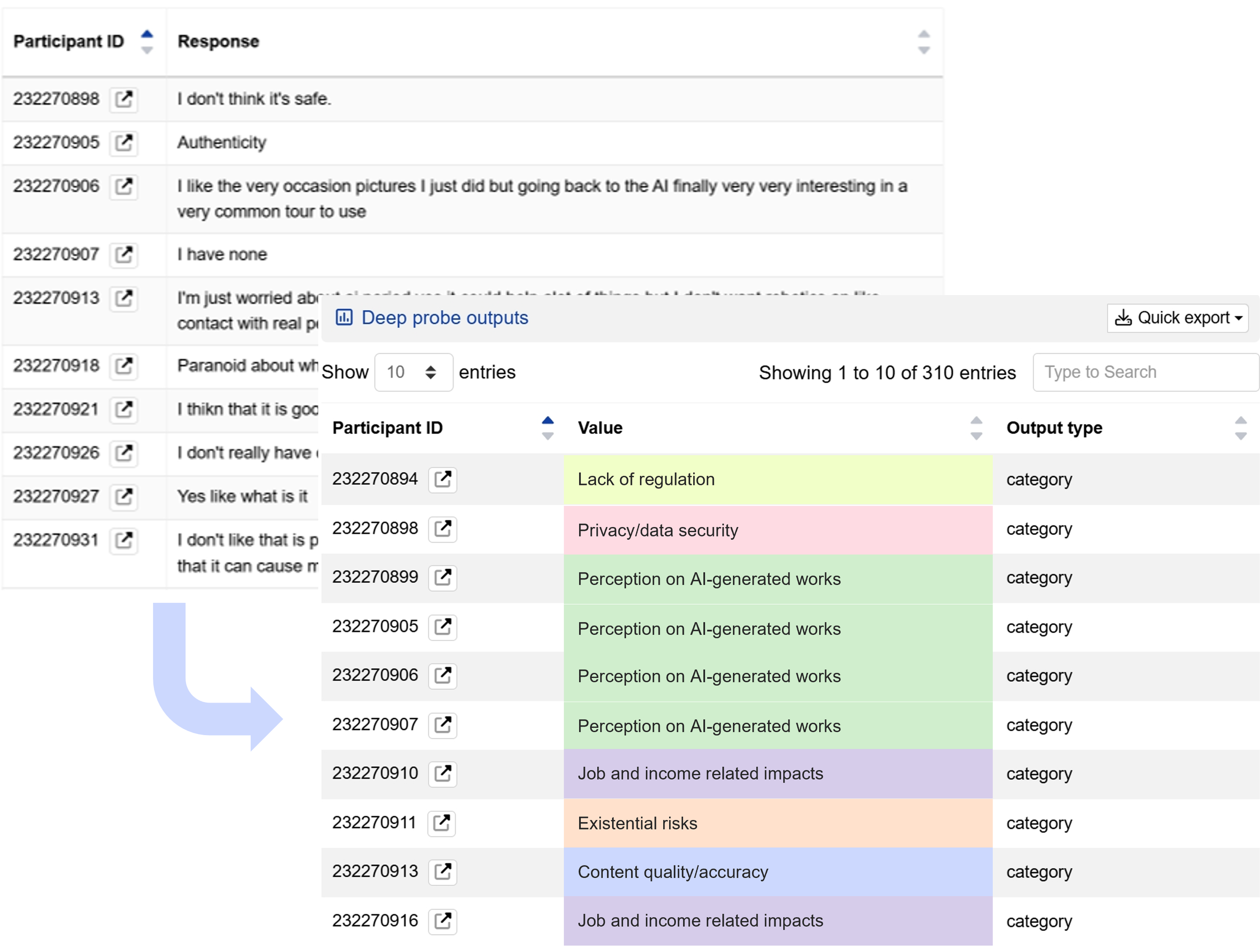
When you need to go deeper, Deep probe lets you query your open-ended data directly in plain language. Ask it to group responses into categories, count how often key themes appear, or test a specific hypothesis, then drill into individual responses behind any result, all without manual coding required.
Ready to add a qualitative layer to your next study?
If you’re planning a project and want help deciding which option fits, whether that’s using a conversational survey, incorporating video responses and open-ended questions into your survey, or using Deep probe to analyse data you’ve already collected, feel free to schedule a consultation.