

Conjointly surveyed 554 US respondents across eleven research panels in 2026 to compare panel experience and earnings, with year-on-year shifts since the 2025 study.
Online research panels provide opportunities and spaces where participants share their opinions and insights. To uncover how respondents feel about their participation across different platforms, Conjointly collected feedback from 554 US respondents across eleven research panels in June 2026. This is an update to our 2025 panel experience study, and it tracks how participant experiences have evolved over the past year. This overview presents their demographics, satisfaction with different aspects of their panel experience, monthly survey completions, and estimated earnings, alongside comparisons to the 2025 findings.
Respondent demographics
This survey did not implement any targeted quotas for participation. The demographics presented reflect the natural composition of respondents who completed the survey.
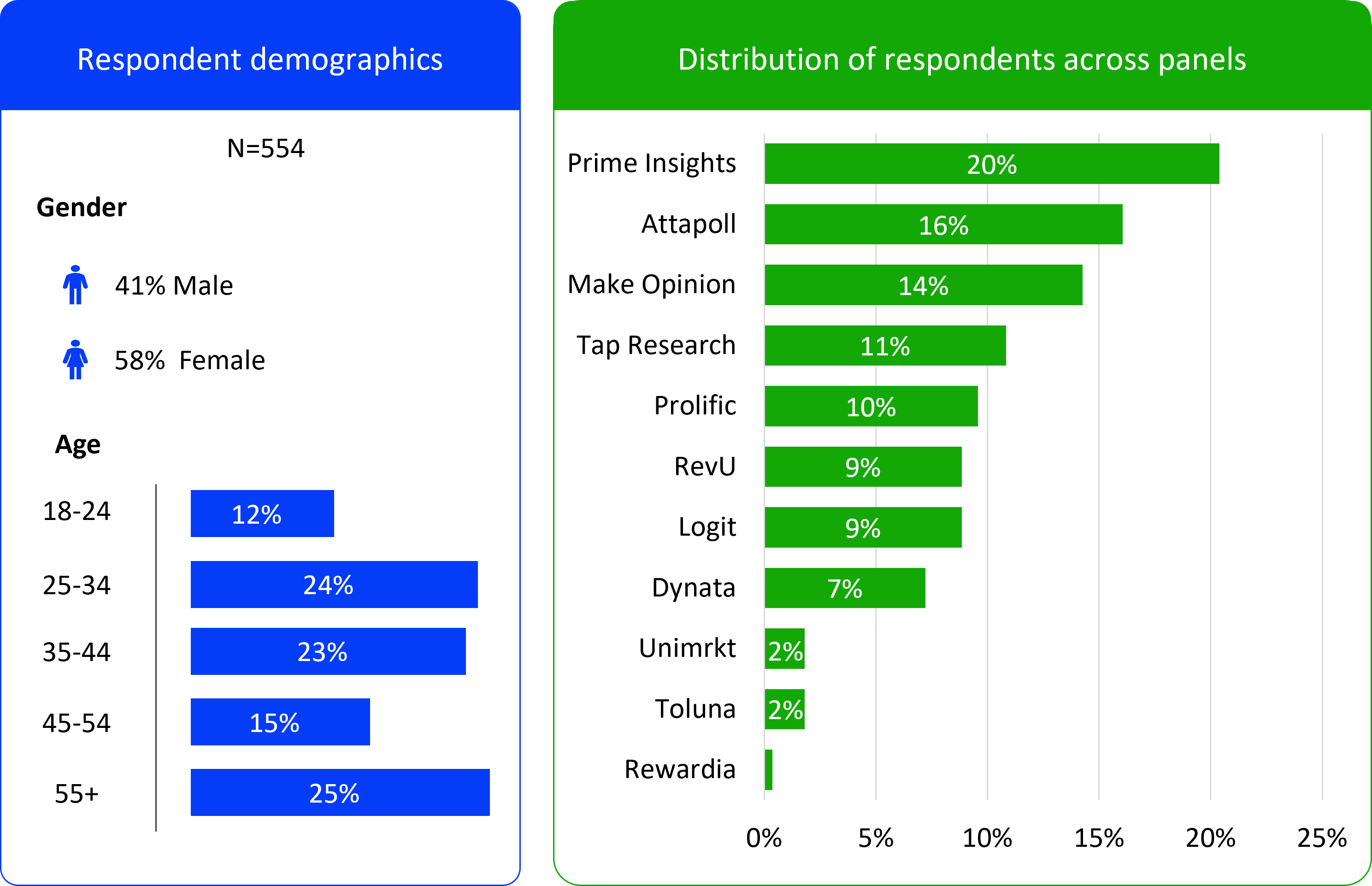
After cleaning low-effort responses, the sample consists of 554 US respondents, 58% female and 41% male, with 1% selected other/prefer not to say. That is nearly identical to the 2025 sample (59% female and 41% male), suggesting strong year-on-year consistency in who joins online research panels.
The age distribution remains broadly similar to 2025. Those aged 55 and older continue to form the largest segment at 25%, followed by 25-34 year-olds at 24%, 35-44 year-olds at 23%, 45-54 year-olds at 15%, and 18-24 year-olds at 12%. The slight uptick in 25-34 year-olds (from 21% in 2025) and 35-44 year-olds (from 21%) suggests a modest shift towards middle-aged adults entering online research panels.
The 2026 wave covered eleven panels: Prime Insights, AttaPoll, Make Opinion, Tap Research, Prolific, RevU, Logit, Dynata, Unimrkt, Toluna, and Rewardia. Prolific and Unimrkt are new this year. Notably, Toluna and Rewardia could not supply the same number of respondents as in 2025, and Qmee returned no completes. As a result, the 2026 sample is somewhat smaller than 2025 (554 versus 639 respondents).
As last year, the most responses came from Prime Insights (20%). The survey again covered both panels that rely on dedicated panel sites and apps (for example AttaPoll and Prime Opinion, which is part of Prime Insights) and those that serve surveys through third-party game and other apps (for example RevU).
Panel membership duration
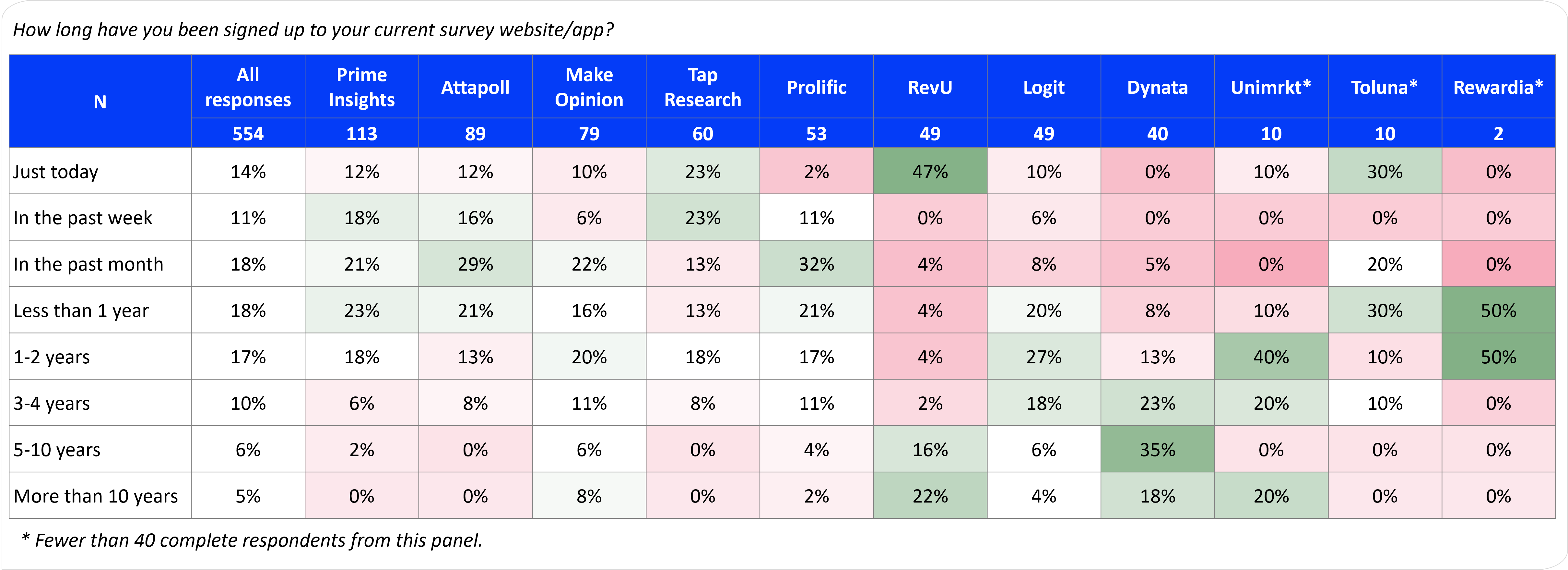
Across all panels, most respondents are relatively recent joiners. In 2026, 62% had been members of their current panel for under a year. That breaks down into 14% who joined the same day, 11% in the past week, 18% in the past month, and 18% earlier in the year. This points to a consistent flow of newer panellists, mirroring the 2025 pattern, where 63% had joined within the past year.
RevU attracted a high proportion of both very new and long-tenured members, with 47% joining the same day and 39% having been members for more than five years. Logit showed a notable concentration in the 1-2 year range, with 27% of its respondents in that band. Dynata reported the most established participation, with 75% of members having participated for three or more years.
Panel experience
Participants were asked five 5-point Likert-scale questions to assess their experience with their respective panels:
- How satisfied are you with the ease of navigating the survey website/app?
- How satisfied are you with the ease of completing surveys?
- How satisfied are you with the frequency of survey invitations?
- How satisfied are you with the rewards offered after completing surveys?
- How likely are you to recommend this survey website/app to others?
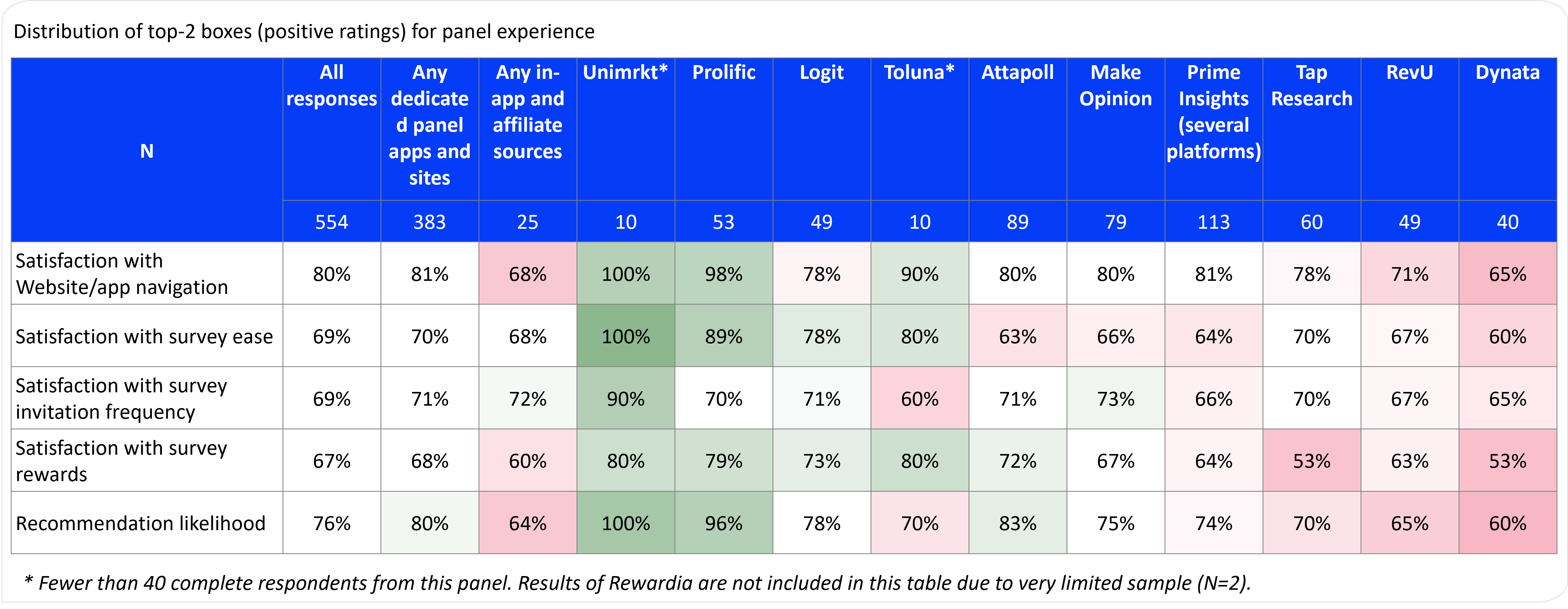
Overall satisfaction across panels remains generally positive in 2026, especially for Prolific. Website/app navigation scores the highest overall at 80% top-2-box across all respondents, unchanged from the strong performance in 2025 (82%), and Prolific (98%) led on this dimension. Survey ease sits at 69% overall, with Prolific (89%) and Logit (78%) scoring notably higher. Survey invitation frequency also registers 69% overall.
Satisfaction with rewards comes in at 67% overall, continuing the lowest-rated pattern from 2025. Prolific scored 79%, Logit 73%, and AttaPoll 72%, while Tap Research and Dynata (both at 53%) trailed the field. Recommendation likelihood remains strong at 76% overall, with Prolific (96%) leading and RevU (65%) and Dynata (60%) at the lower end.
Panel earnings
Average monthly survey completions
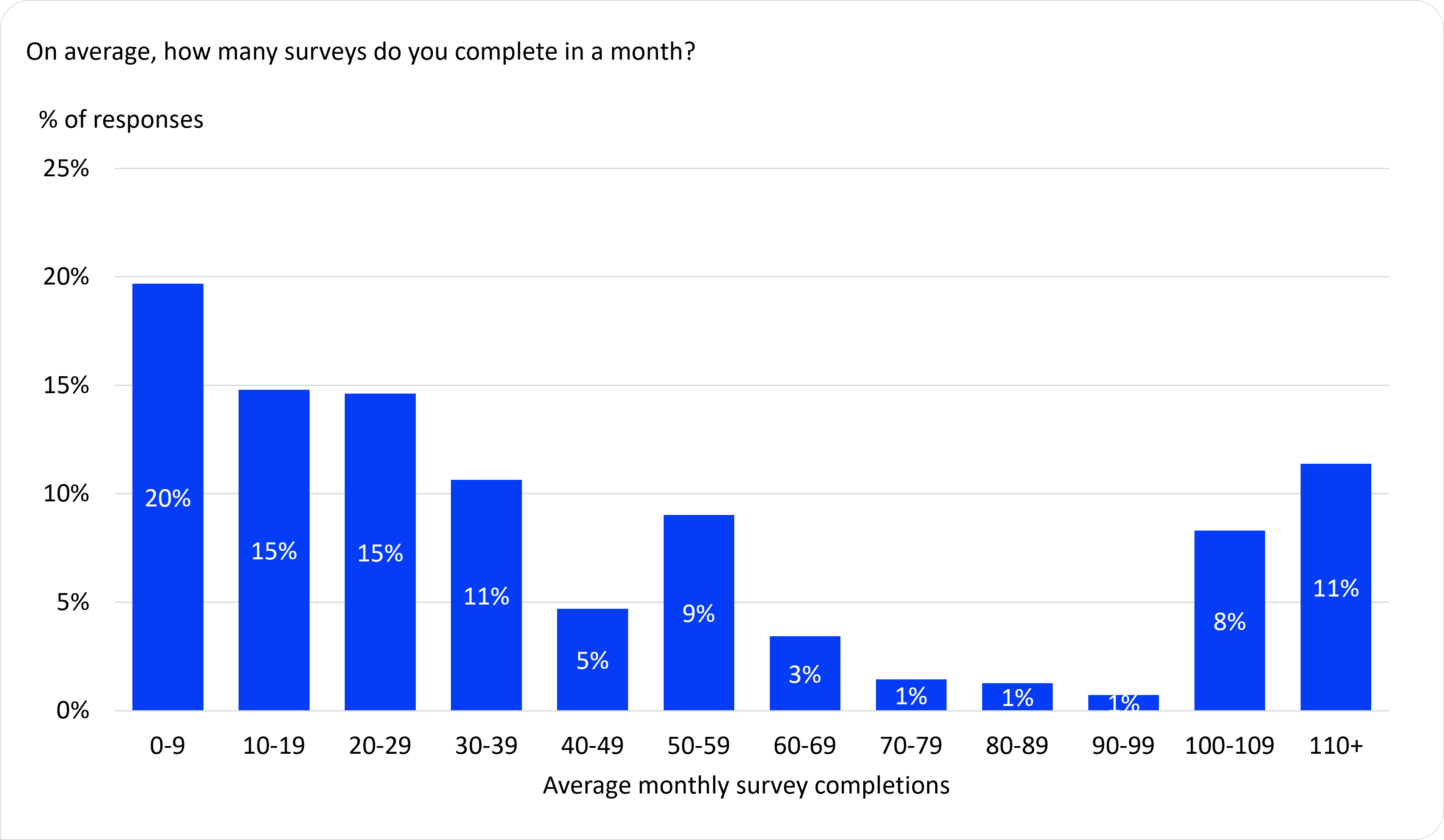
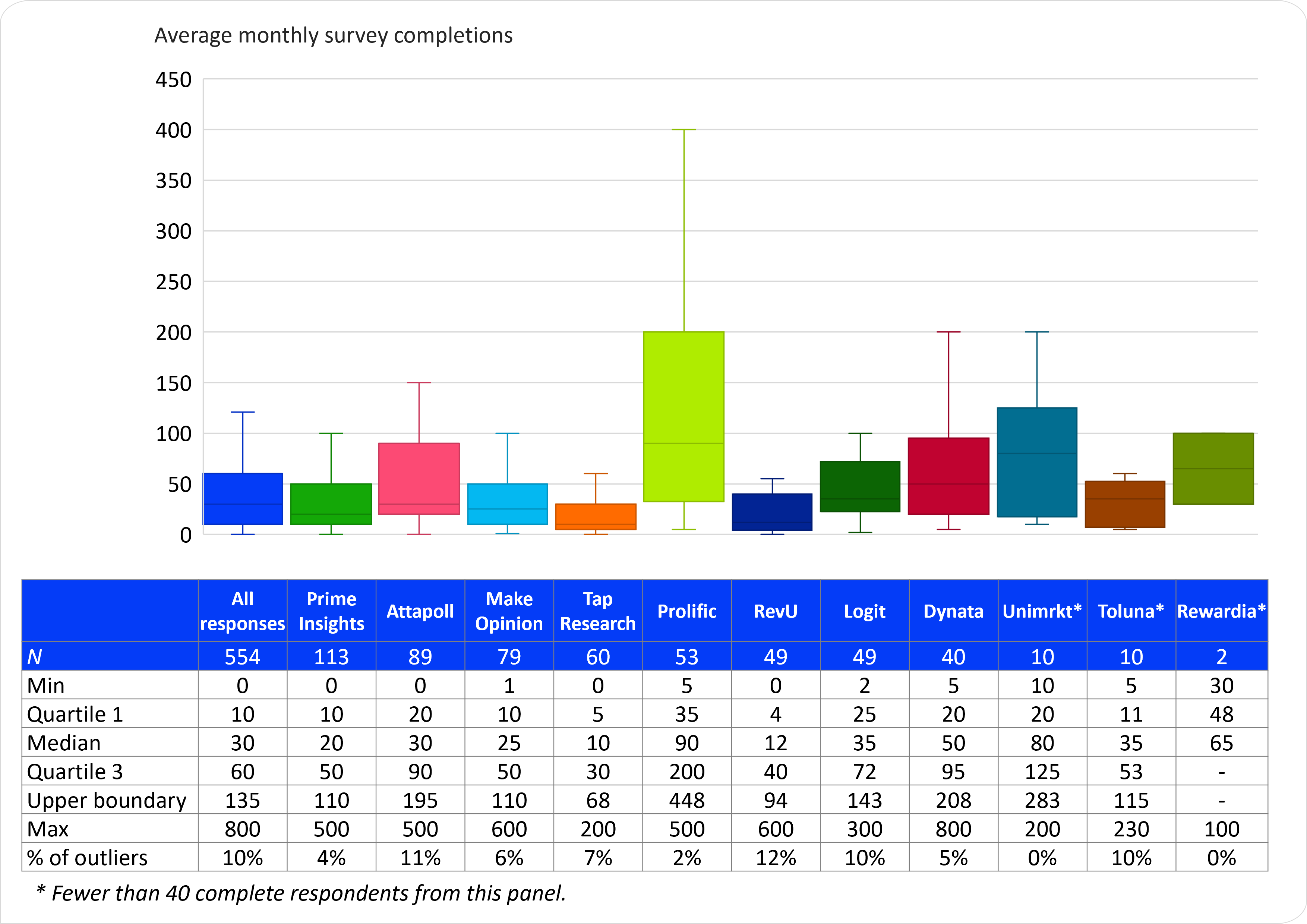
In 2026, 20% of respondents completed 0-9 surveys monthly, the most common band, followed by 15% each in the 10-19 and 20-29 ranges. In total, 50% of respondents completed fewer than 30 surveys per month, broadly in line with the 2025 figure of 54%.
The 2026 distribution shows a notably larger cluster of very active respondents. In 2026, 11% completed 110 or more surveys monthly, compared with a somewhat smaller high-frequency segment in 2025 (where 8% reported 110+ surveys per month). This suggests the active tail of the respondent pool remains substantial, though the distribution across brackets has shifted slightly.
As in 2025, the understanding of a “complete” survey likely varies between respondents and researchers. Some respondents may count surveys where they were screened out, while researchers typically count only fully qualifying completes.
The bimodal distribution holds across all panels in both years, where most participants complete a moderate number of surveys while a small cohort is very active. The box plot comparison reveals continued variation in completion patterns. Respondents from Prolific and Dynata had slightly higher median monthly survey completions at 90 and 50, while those from Tap Research and RevU continued to show lower completions, with medians of 10 and 12 surveys monthly.
Looking at the distribution of responses, participants from Prolific reported the widest spread of typical monthly completions. Dynata again shows one of the wider spreads, indicating highly variable engagement levels among its panellists. The upper boundary value represents the statistical threshold above which responses were considered outliers (calculated as Q3 + 1.5 × IQR). For Dynata, the typical range extended to 208 surveys monthly, while some participants reported values as high as 800.
The percentage of outliers indicates what proportion of each panel’s respondents reported unusually high monthly survey completions. RevU (12%) and AttaPoll (11%) had a slightly higher share of statistical outliers, while Prolific (2%) and Prime Insights (4%) stayed lower than other platforms.
Average earnings per complete survey
The 2026 earnings-per-survey distribution shows a broadly similar pattern to 2025, with some notable shifts.
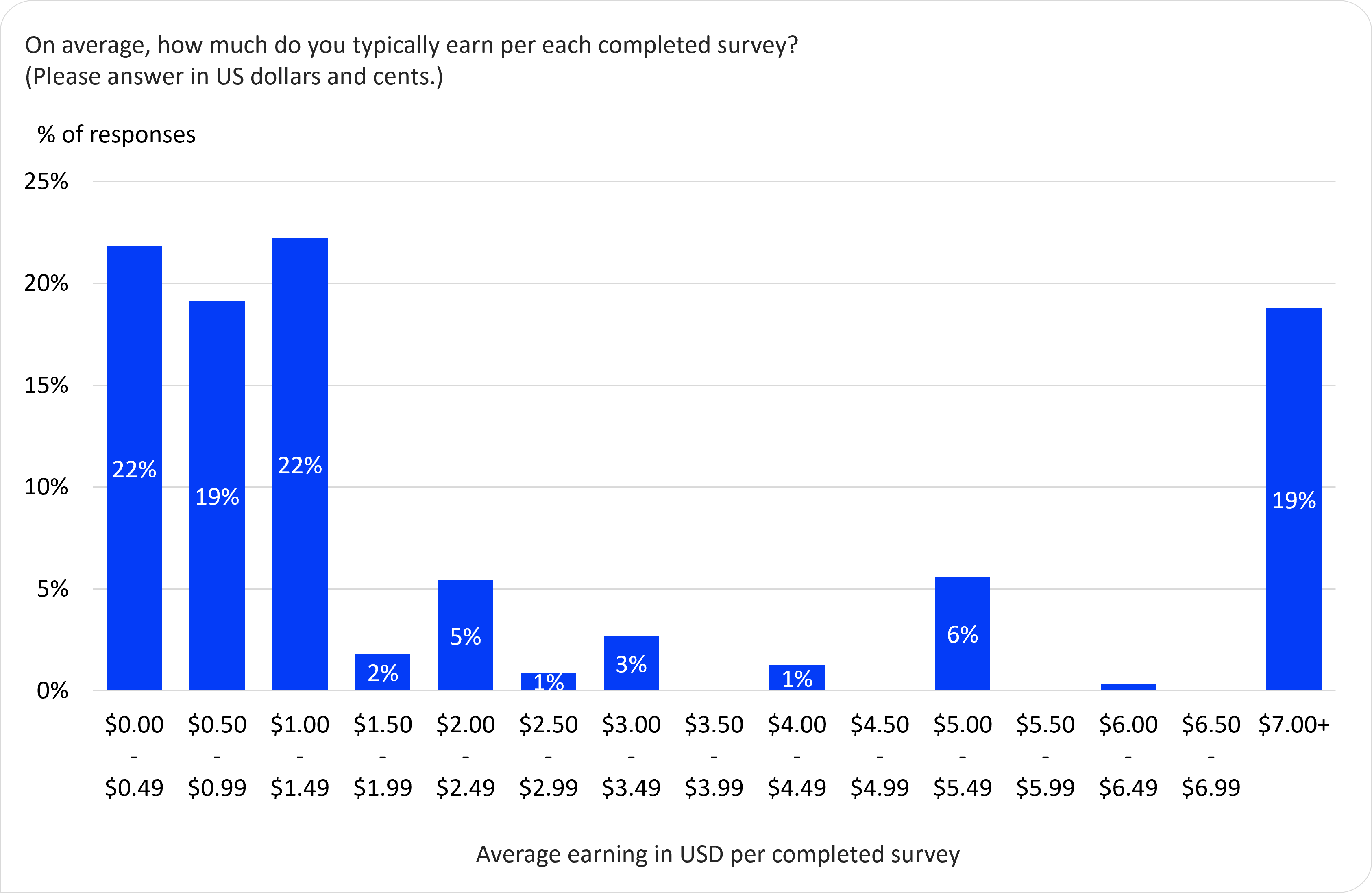
In 2026, 63% of respondents reported under $1.50 per survey, nearly the same as the 64% recorded in 2025. The $0.00-$0.49 and $1.00-$1.49 bands are jointly the most common at 22% each, compared with the 2025 finding where $0-$0.49 was the single most common band at 28%. This suggests a modest upward shift in per-survey compensation. A sizeable 19% of respondents reported $7.00 or more per survey, similar to the 21% who reported $7.00+ in 2025, again indicating likely overstatement of rewards at the high end, or the inclusion of higher-paying specialised studies.
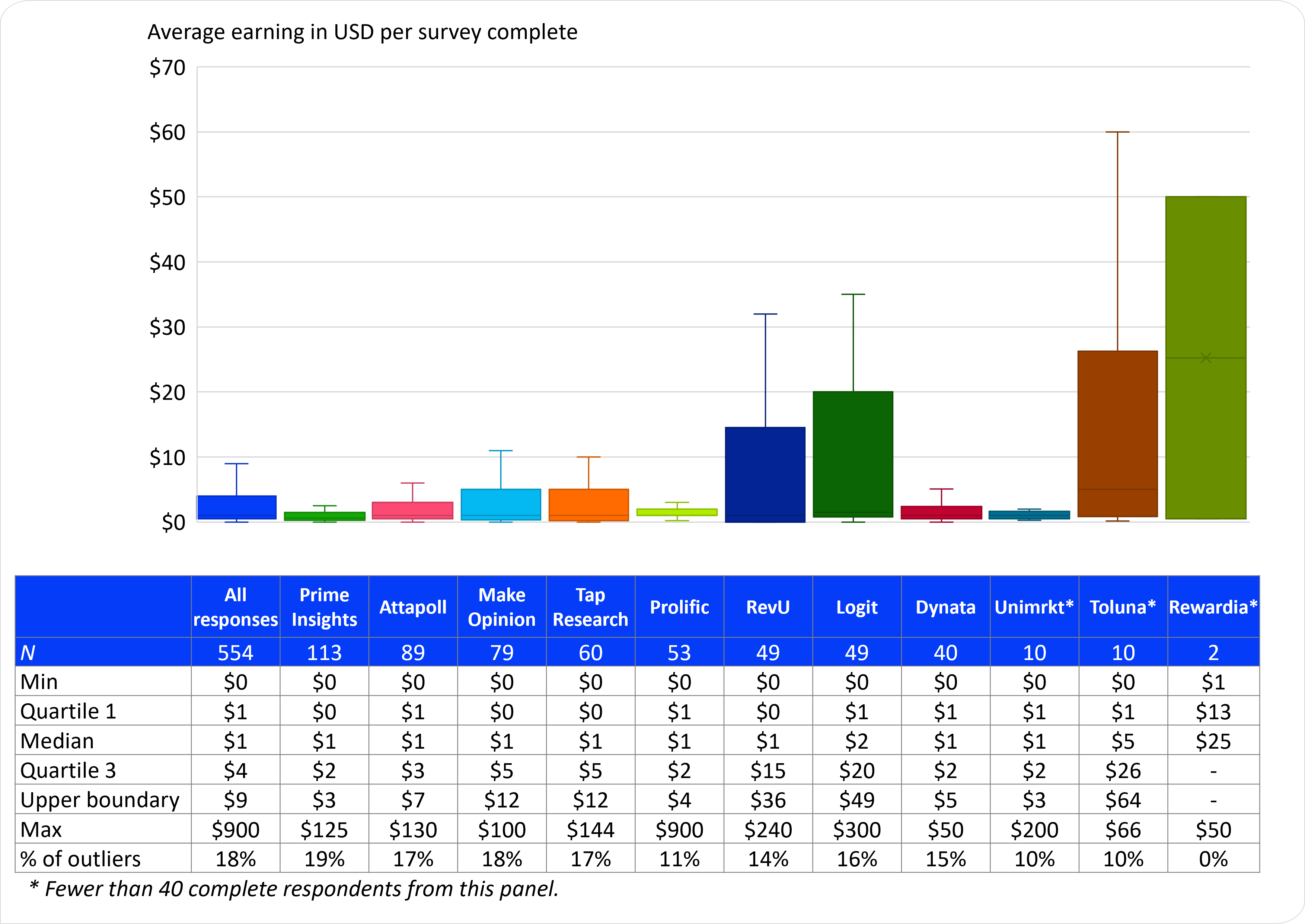
The median reported earnings per survey across panels remains around $1.00, consistent with 2025. Box plot variation across panels is similar, with some panels showing wider upper-quartile ranges. Among panels with a meaningful sample size, Logit and RevU again reported the highest potential earnings (Q3 values of $20 and $15 respectively).
The distribution of earnings was heavily skewed. Most respondents clustered at lower payment levels, with a long tail extending to much higher reported amounts. Statistical outliers ranged from 11% to 19% of responses across the larger panels.
Average monthly earnings from completing surveys
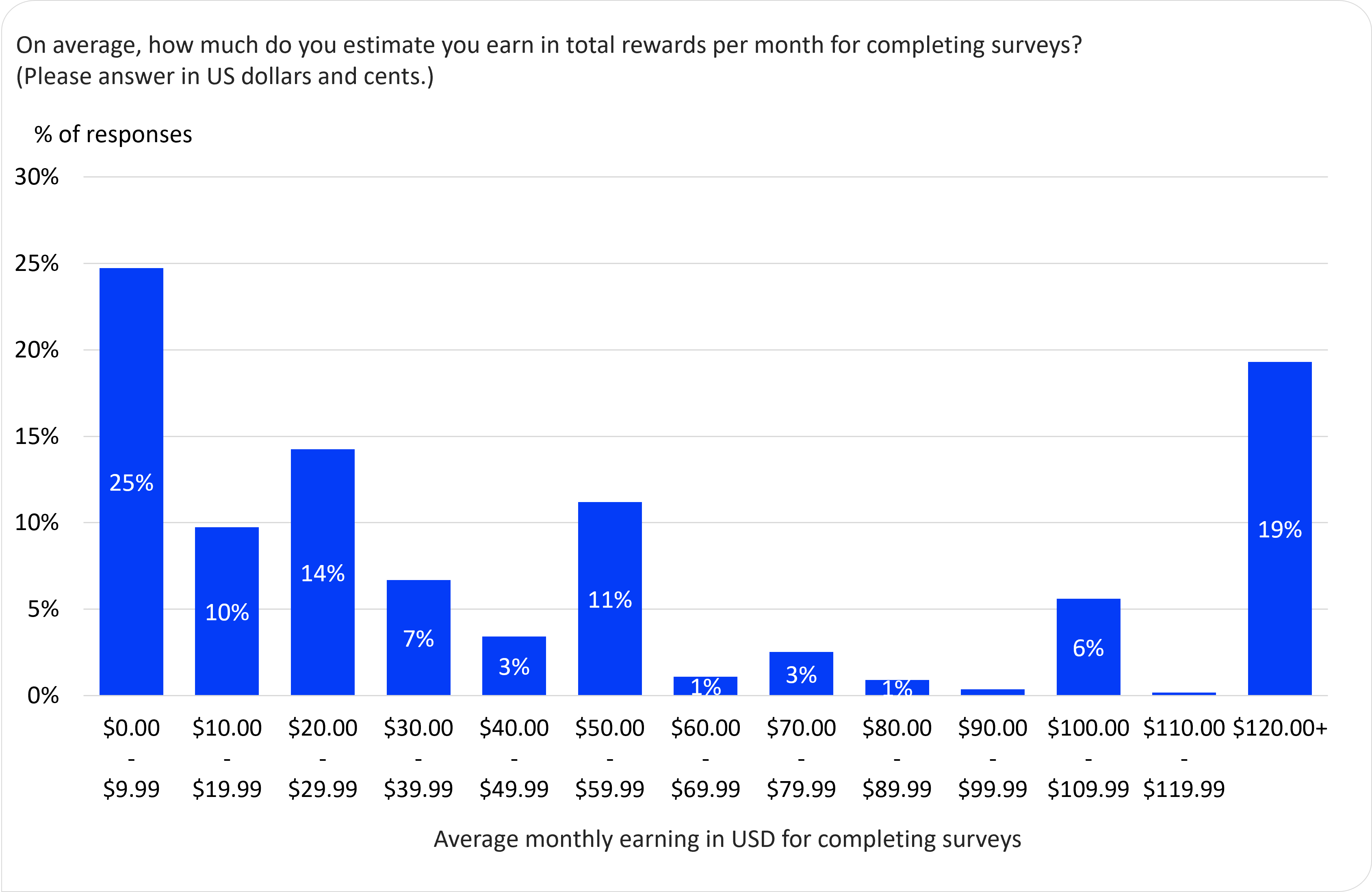
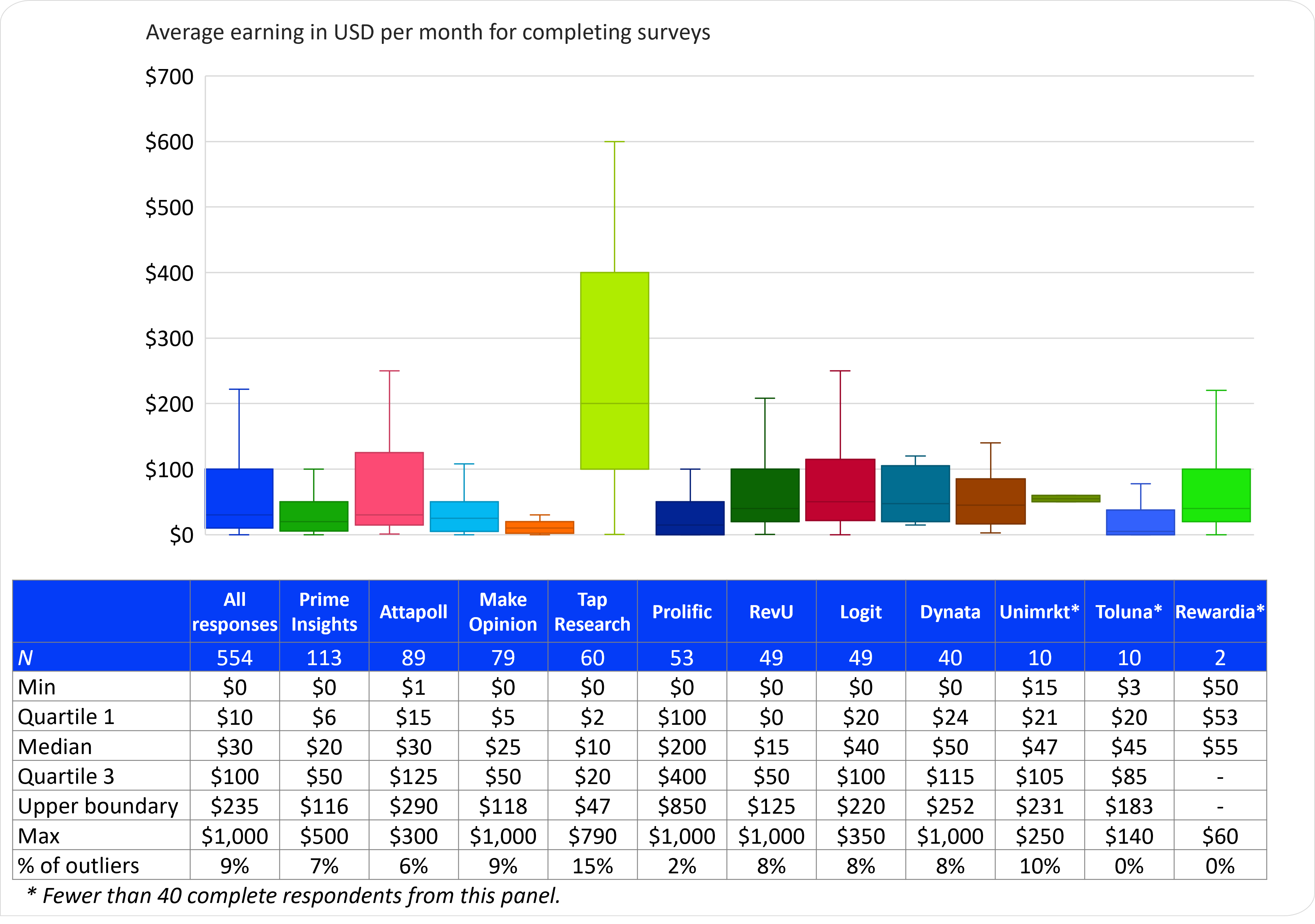
The monthly earnings distribution in 2026 continues to show a long-tail pattern, with most respondents clustered in lower brackets ($0.00-$29.99) but a notable segment at the high end ($100+).
The $0.00-$9.99 band is the most common at 25% of respondents (up from 23% in 2025), suggesting a slightly larger group of lower earners or more casual participants. Combined, 49% of respondents earned less than $30 per month, compared with 58% in 2025.
The $50.00-$59.99 band forms a notably large cluster at 11%, which differs from the more continuous tapering in 2025 (where that band sat near 8%). A further 19% reported earning $120 or more monthly, much higher than the roughly 10% who reported $120+ in 2025. This suggests either growth in the active earner segment or upward inflation in earnings reports, though part of the rise reflects the new high-earning panels in the mix.
The median monthly earnings across all panels in 2026 is approximately $30, higher than the $22 median recorded in 2025, though part of that gap reflects Prolific joining the mix at the top of the range. Panel-level variation remains. The new panel, Prolific, has the highest median monthly earnings at $200, with Dynata higher at $50 and Tap Research and RevU at the lower end ($10 and $15).
Looking at the potential for higher earnings, Prolific ($400), AttaPoll ($125), Dynata ($115), and Logit ($100) showed upper-quartile values at or above $100. Most panels reported similar outlier percentages between 7% and 10%, with Tap Research recording the highest proportion at 15% and Prolific the lowest at 2%.
Open-ended feedback
Open-ended responses were analysed using an AI-assisted thematic summary over the actual respondent comments. The feedback reveals a set of persistent structural concerns that closely mirror the themes identified in 2025, alongside a notable minority of genuinely positive experiences.
- Disqualification without compensation is the single most common complaint in 2026. Respondents describe being screened out mid-survey, or even at the point of completion, without receiving any reward, and call it both wasteful and unfair. This theme was present in 2025 too, framed as frequent disqualification after spending significant time on a survey. In 2026 it emerges as the dominant grievance rather than one concern among several, suggesting it has worsened or become more salient.
- Inaccurate time estimates are a newly prominent theme in 2026. Many respondents note that surveys routinely take significantly longer than advertised, making it difficult to judge whether participation is worthwhile before committing. Survey length was mentioned in 2025, but the framing has sharpened: panellists in 2026 are specifically frustrated by the inability to make an informed decision at the outset.
- Low pay remains a widespread concern, with many respondents feeling current payouts do not reflect the time and effort required. This is consistent with 2025 findings, and with reward satisfaction continuing to score as the lowest-rated dimension in the quantitative results.
- Technical issues and broken surveys persist across platforms, with frequent reports of surveys crashing, freezing, or failing to credit rewards upon completion. A new dimension in 2026 is the emphasis on poor customer support. Respondents feel complaints about missing credits or broken surveys are dismissed or ignored, with no meaningful resolution offered.
- Insufficient survey availability gains more explicit attention in 2026. Respondents note that too few surveys are available, with growing user bases diluting access to studies. This may reflect a broader market dynamic, as panel membership has grown while research budgets have not kept pace.
A notable minority of respondents express genuine satisfaction with their panel experience. Positive themes include ease of use, interesting survey content, fast payouts, and the tangible value of earning supplemental income. This is consistent with 2025, where appreciation for quick payouts, low cash-out thresholds, and the enjoyment of sharing opinions were similarly noted.
Suggestions included:
- Better vetting of survey authors to enforce accurate time estimates and fair minimum pay rates, ensuring respondents can make informed decisions before committing to a survey.
- Partial compensation for respondents screened out mid-survey, alongside smarter panellist-to-survey matching to reduce irrelevant invitations and wasted time.
- A dedicated support process for missing or disputed credits, with clear resolution timeframes, to address the perception that complaints are dismissed or ignored.
Overall, while many respondents appreciate the opportunity to earn money through surveys, persistent issues with unfair disqualification, inaccurate time estimates, low pay, and poor technical reliability significantly undermine the experience. The 2026 feedback suggests the industry has made limited progress on these pain points since 2025. The concerns are not only the same but, in some cases, are felt more acutely by participants.
Year-on-year summary
Overall, the 2026 wave reveals a research panel landscape that is largely consistent with 2025 in its structure and participant experience. Satisfaction patterns, the demographic composition of panellists, and the key pain points around compensation and disqualification all remain broadly stable.
A standout finding is the new panel, Prolific, which performs well across satisfaction measures and posts higher median monthly survey completions, higher median monthly earnings, and stronger earning potential.
The other notable shift is that more active members, and a larger proportion of respondents in 2026, report earning $120 or more per month, though part of that reflects the new panels in the mix. Set against the feedback around insufficient survey availability, it may point to participant demand outpacing supply.
Reward satisfaction continues to be the dimension most in need of attention across the industry. Until platforms address compensation expectations more effectively, particularly around disqualification and survey-length accuracy, it is likely to remain the persistent weak point in the panel participant experience.
Conjointly continuously monitors panel quality and respondent experience to ensure your survey respondents are genuine, engaged, and fit for the decisions you base on them. You can source real human respondents swiftly and at scale through Conjointly’s sampling services, ISO 20252:2019 certified, with rigour, transparency, and ethical conduct.