

Which ride-sharing app dominates consumer minds in the US? What are the primary occasions that trigger a ride-sharing booking? And what frustrations remain unaddressed across the category? This article explores US ride-sharing app usage and attitudes, and shows the additional layer of insights conversational surveys can provide.
Conversational Survey
Engage your consumers with interactive chat surveys
Ride-sharing has reshaped urban mobility around the world. In the US, millions of consumers use services like Uber and Lyft daily. Yet, what drives them to choose a particular app over another, when they reach for ride-sharing over other transport options, and which pain points remain unaddressed are surprisingly underexplored.
To fill this gap, we ran a usage and attitude (U&A) study on ride-sharing app usage with 105 US respondents. Rather than relying solely on structured questions, we used Conjointly’s conversational surveys to conduct semi-structured, AI-moderated interviews, and coded the open responses into structured, quantifiable outputs for analysis using Deep probe.
Key findings
Uber is top-of-mind for 75% of respondents unprompted. Lyft comes in second at 31%, with some overlap among users who regularly use both.
The #1 booking occasion is “personal vehicle unavailable or impractical”, a constraint-based trigger that would likely have been missed by a predefined choice list.
Service reliability, including wait times, driver availability gaps, and cancellations, accounts for 62% of primary frustrations, ahead of pricing-related concerns.
Around half of both Uber and Lyft users would recommend their preferred app unconditionally (51% and 50%). Beyond that, Lyft users are more likely to recommend with caveats (46% vs. 29% for Uber).
Research design
Understanding why someone books a ride, what pushes them towards a particular app, and what frustrations they carry involves personal context and requires room for respondents to describe their experience.
That is what the semi-structured conversational surveys are built for. This approach is structured enough to produce comparable data, yet flexible enough to uncover the specific situations, trade-offs, and hesitations that fixed-format questions cannot anticipate.
The conversational interview followed a fixed sequence, where the AI moderator followed the thread of each respondent’s actual experience, probing where needed and moving on when responses were sufficient:
- Which ride-sharing app or service do you use most frequently?
- Why do you choose that app over alternatives?
- What occasions or situations typically lead you to book a ride?
- What do you think about right before confirming a booking?
- What has been your single biggest frustration with ride-sharing services recently?
- Would you recommend your primary app to a friend or colleague, and why?
Below is the complete AI interviewer prompt we used for the conversational survey:
Another practical advantage of Conjointly's conversational surveys is the ability to combine open-ended AI interviews with standard structured questions in a single study.
Here, we included a multiple choice question on usage frequency and a Likert-scale question on overall satisfaction. These gave us a basis for segmenting respondents and exploring how different groups responded to the conversational questions.
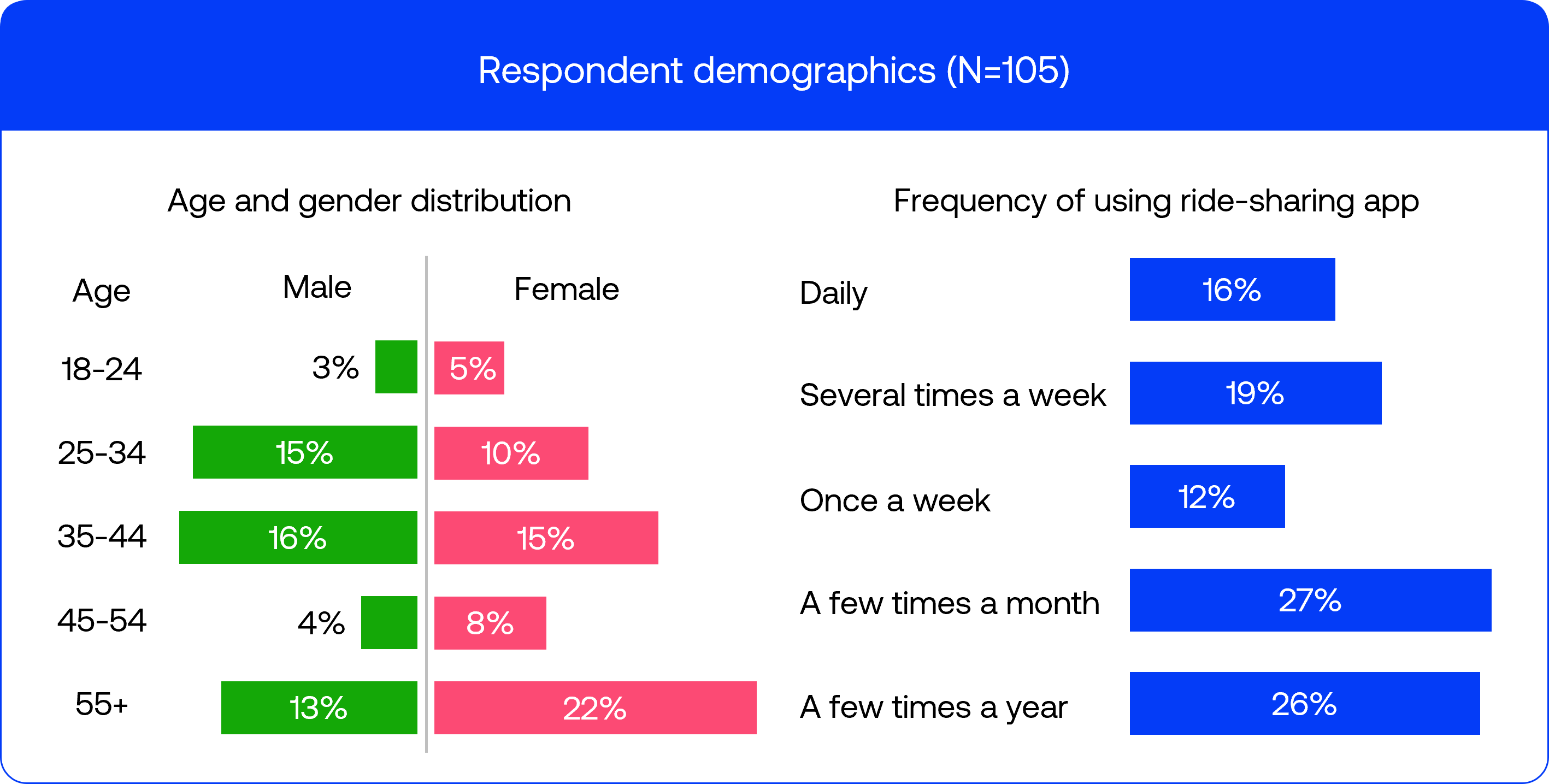
The study surveyed 105 US ride-sharing users in June 2026 using Self-serve sample. Based on the usage frequency reported, 47% of respondents use ride-sharing at least once a week, with 35% using it several times a week or more. The remaining respondents are split between occasional users who ride a few times a month (27%) and infrequent users who ride a few times a year (26%).
Uber leads on unprompted app preference
The first conversational question asked respondents to name their most used ride-sharing app without presenting them with a list.
Uber was the dominant platform, mentioned by 75% of respondents (79 out of 105). Lyft came up in 31% of responses (33 out of 105). As respondents could mention more than one platform, the total exceeds 100%.
Among those who used multiple platforms, 9 used both Uber and Lyft. Notably, only 2 respondents mentioned other ride-sharing apps, such as Waymo and Wingz.
The numbers tell part of the story, but the reasons behind each preference are more revealing. Uber users cited reliability, availability, competitive pricing, and ease of use. This breadth of reasons may help explain Uber’s wider user base, with different users valuing different strengths.
Why do you choose Uber over the alternatives?
AI summary of answers
Users choose Uber over alternatives primarily due to its ease of use, competitive pricing, and reliability. Many appreciate the availability of drivers, the app's user-friendly interface, and the sense of safety it provides. Additionally, some users have memberships or loyalty to Uber, which further incentivises their choice.
Lyft users told a more focused story. Price and affordability dominated their stated reasons, with respondents specifically citing lower fares and less aggressive surge pricing as their primary reasons for choosing or staying with Lyft.
Why do you choose Lyft over the alternatives?
AI summary of answers
Price and affordability are cited as the dominant drivers of choice by the vast majority, who consistently highlight lower fares, less aggressive surge pricing, and better value compared to competitors such as Uber. Safety features are noted by several respondents, including those who select female drivers or rely on Lyft specifically for late-night travel. Availability and coverage play a role for respondents in areas with limited alternatives.
Personal vehicle unavailability is the top booking trigger
As ride-sharing occasions vary considerably across participants, the conversational format provides space for them to describe their usage in their own words rather than selecting from a researcher-defined list.
Through Deep probe, we coded these responses into major themes based on what respondents described.
| Occasion | % of respondents |
|---|---|
| Personal vehicle unavailable or impractical | 33% |
| Social outing or nightlife | 18% |
| Daily commute (work or school) | 16% |
| Airport or long-distance travel | 11% |
| Medical or healthcare appointments | 7% |
| Shopping or errands | 7% |
| Bad weather or inconvenient travel | 4% |
| Tourism or exploring a new area | 3% |
| Special occasions or events | 1% |
The top category is not a specific trip type, but a constraint. People book a ride when their car is unavailable, parking is impractical, or driving simply is not an option.
In hindsight, if a predefined list of only trip-based occasions had been used, it might have missed this entirely, as these constraints would not have appeared as standalone options on the choice list.
Frustrations exist despite high satisfaction scores
The overall satisfaction question in the survey returned a mean of 4.18 out of 5, with 80% of respondents in the top two boxes.
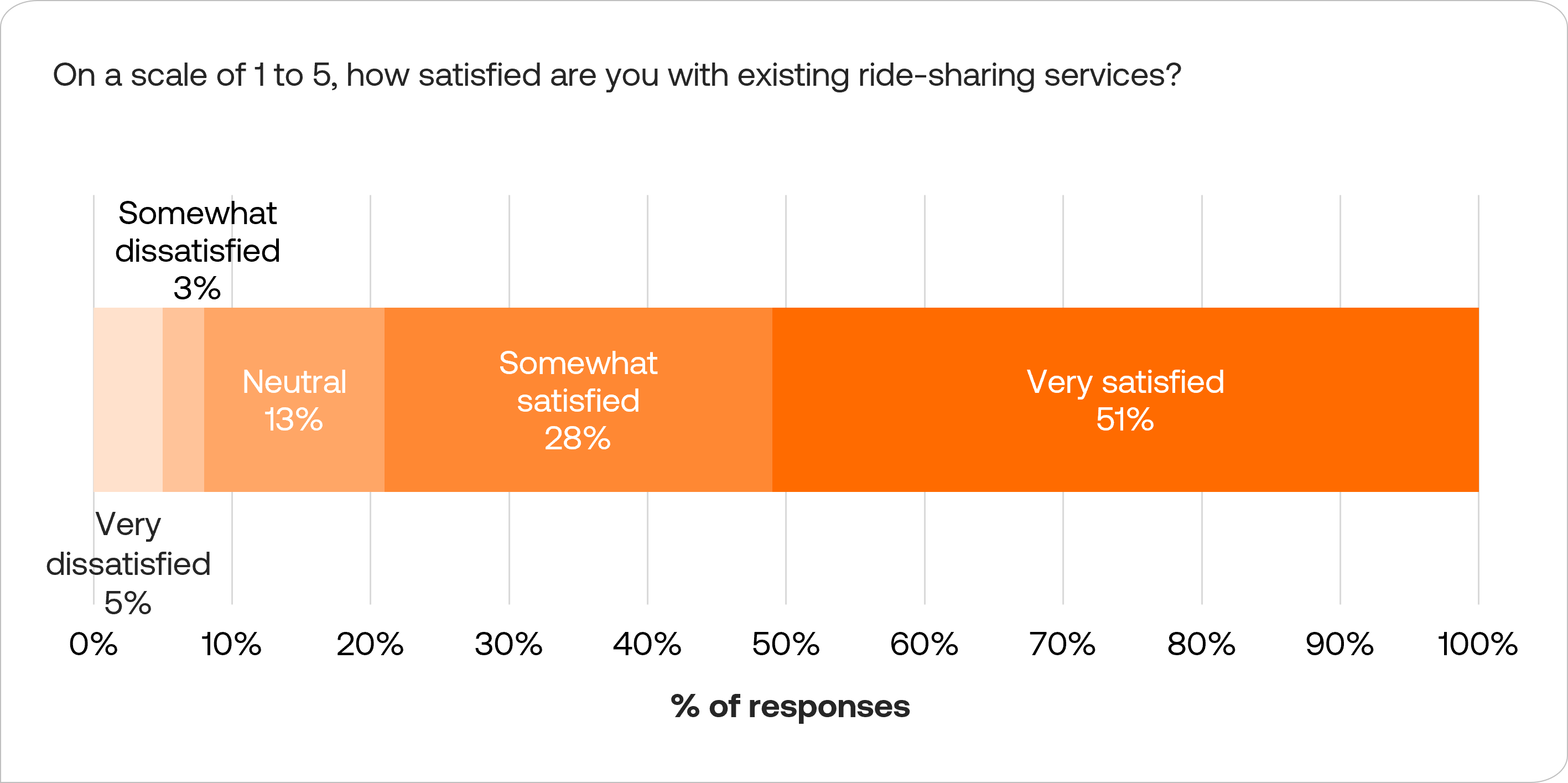
Notably, this figure barely shifts across usage frequency groups. It sits at 83% top-2-box among frequent users, 76% among once-a-week users, and 84% among those who ride only a few times a year.
On its own, that looks like a strong result. But the conversational responses tell a more complicated story.
Around 29% of respondents reported no notable frustration. Among the remaining 71% who did, Deep probe categorised their primary frustration:
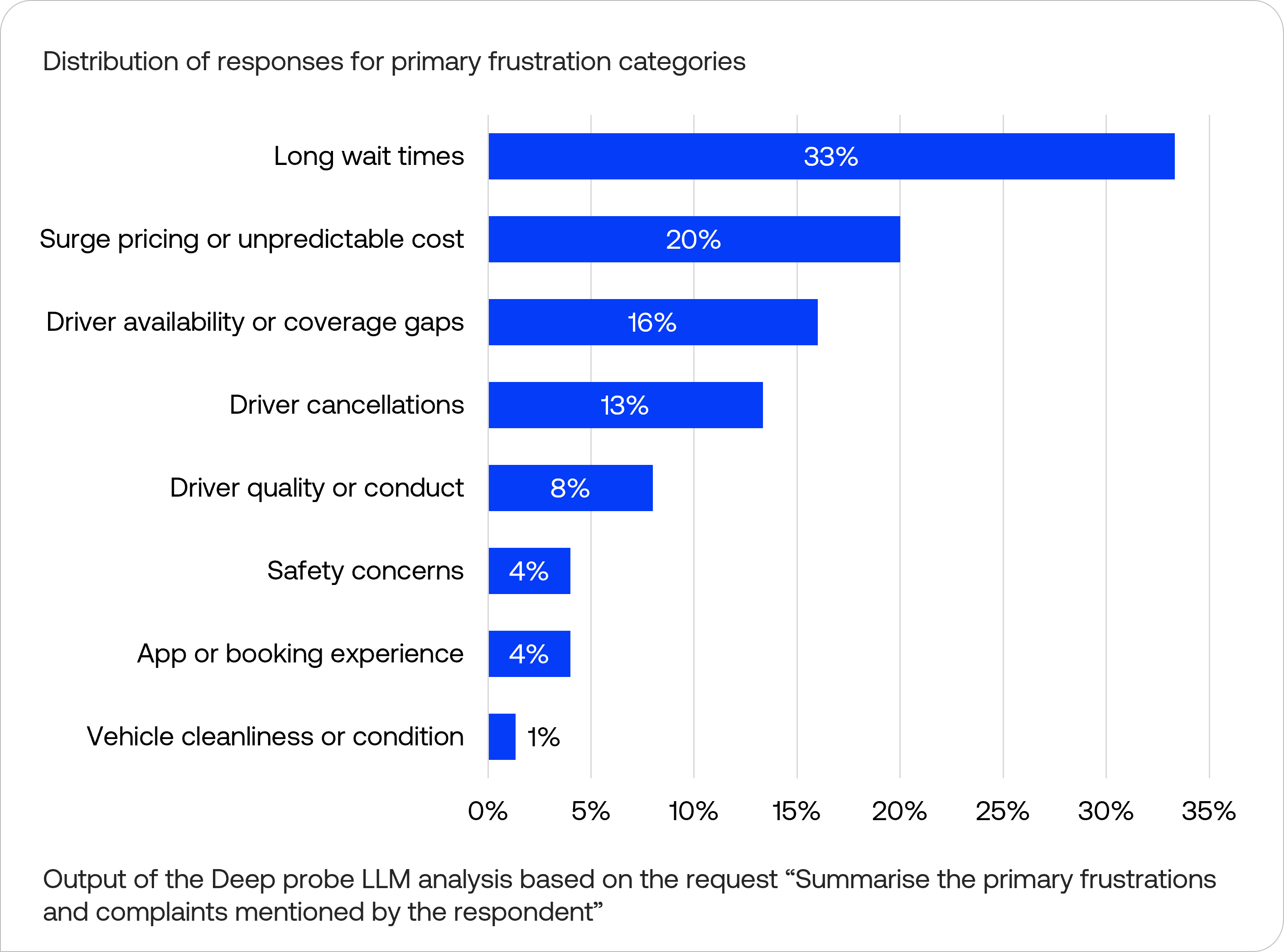
Service reliability, including wait times, driver availability gaps, and cancellations combined, accounts for 62% of coded frustrations. Surge pricing gets most of the attention in public conversation about ride-sharing, but here it ranks as a secondary concern.
A satisfaction scale could not have told us this. The score gives you a number, but the conversation gives you the “why” behind it.
Recommendation intent differs by brand
The conversational survey also asked whether users would recommend their primary app to others. Overall, 83% of respondents would recommend it in some form, which maps closely to the 80% top-2-box satisfaction score.
The more revealing picture emerges when recommendation intent is examined by primary app.
| Category | Uber (n=75) | Lyft (n=28) |
|---|---|---|
| Recommends unconditionally | 51% | 50% |
| Recommends with caveats or conditions | 29% | 46% |
| Neutral or context-dependent | 16% | 4% |
| Would not recommend | 4% | 0% |
Please note that respondents who used only other platforms (n=2) were excluded from this analysis. For the 9 respondents who mentioned both Uber and Lyft, the conversational survey asked one recommendation question based on the first app mentioned, resulting in 5 attributed to Uber and 4 to Lyft.
Combining the top two categories, 96% of Lyft users and 80% of Uber users would recommend their app. The unconditional recommendation rate is nearly identical for both brands, at around 50%.
The conditional picture, however, differs substantially. Lyft users are considerably more likely to qualify their recommendation (46% vs. 29% for Uber), while Uber users are more likely to be neutral or context-dependent (16% vs. 4% for Lyft).
A small minority (4%) of users would not recommend Uber at all. No Lyft user said they would not recommend the app.
It is worth noting that the Lyft sample is considerably smaller, so these results are more directional than precise.
What conversational surveys are good for, and where to go next
Conversational surveys are a research tool with a specific role. It is particularly well-suited for:
- Exploring a category before you know what to measure. This surfaces occasions, decision factors, and frustrations that a well-designed multiple choice question should eventually capture.
- Uncovering categories that would not appear on a predefined list, as the booking occasion data in this study demonstrated.
- Identifying the conditions and nuances behind headline metrics, such as what “I’d recommend it” actually means for different user groups.
It works best as a foundation for further research, or as an additional layer alongside a standard U&A instrument.
For this study, the conversational layer points to a set of clear next steps.
- The occasion distribution suggests that a follow-on structured study should include constraint-based options explicitly.
- The frustration taxonomy is a ready-made input for a driver importance study.
- The contrast between Uber and Lyft users is a sub-segment worth exploring in more depth.
This is where conversational U&A earns its place. It is not a final answer, but a well-grounded foundation for the research that comes next.
If you are planning a U&A study and want to build in this kind of contextual depth, feel free to schedule a consultation.