
A side-by-side look at what conjoint analysis and MaxDiff actually tell you, when to reach for one over the other, and pointers on combining both to get the most out of your research.
Deciding between conjoint analysis and MaxDiff for your next study? Conjointly frequently receives this question at conferences and through support tickets. A common misconception is that these methods are interchangeable. They are not. Each answers different questions, and choosing the wrong one yields data that cannot support your decision.
This article details what each method reveals, compares their outputs, and outlines when to use them. It also covers how to combine both methods and answers common related questions.
What conjoint analysis reveals
A conjoint survey evaluates complete products rather than isolated features.
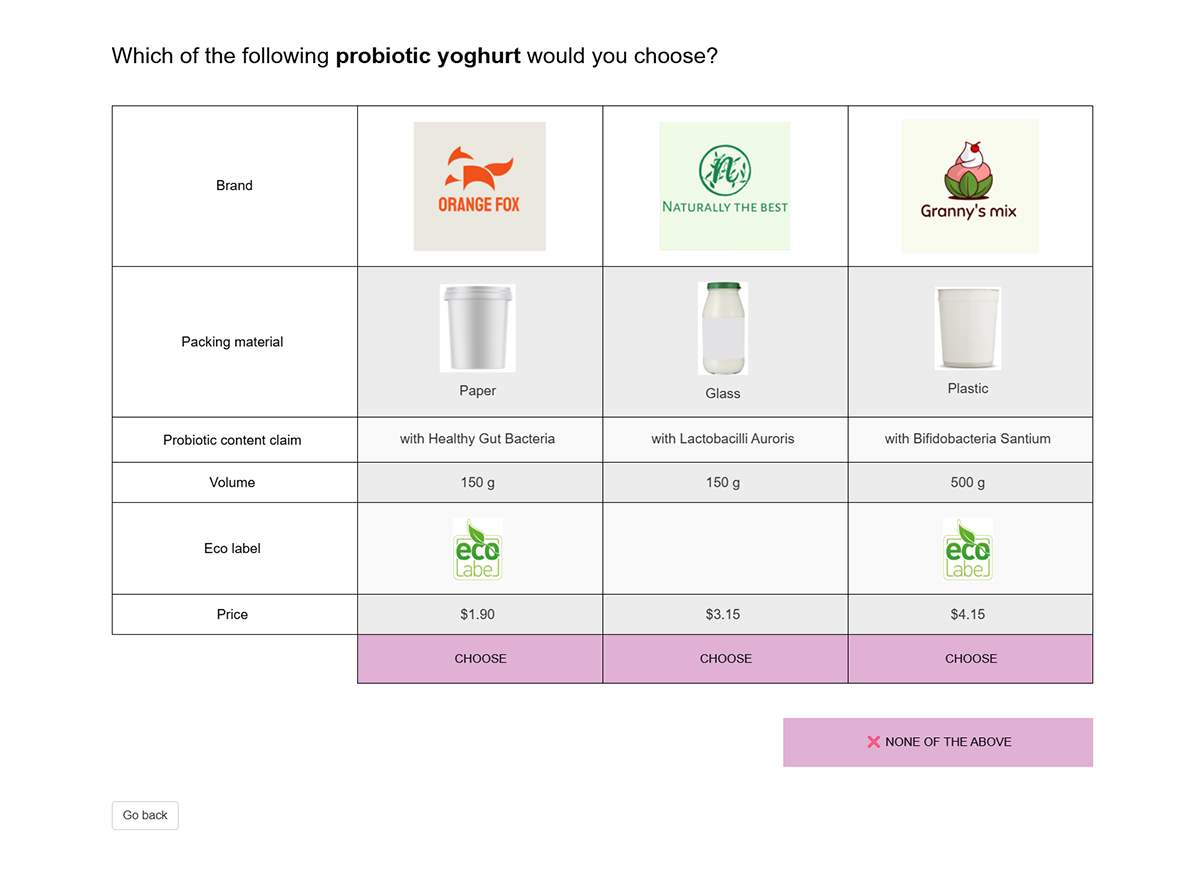
Every product in the survey is built from a handful of attributes. An attribute is a characteristic of the product, such as brand, packaging, health claim, or price. Each attribute is then set to one specific level. For example:
- Price: $1.98, $2.00, or $2.20
- Health claim: organic, natural, or fat-free
- Packaging: glass bottle, plastic cup, or squeeze pouch
Respondents view a few complete products side by side, each featuring a different combination of levels. Just like shopping in a store or online, they select the option they would actually buy. Repeating this across multiple scenarios reveals how customers trade off one feature for another.
Collected across your full sample, Conjointly turns those choices into actionable outputs.
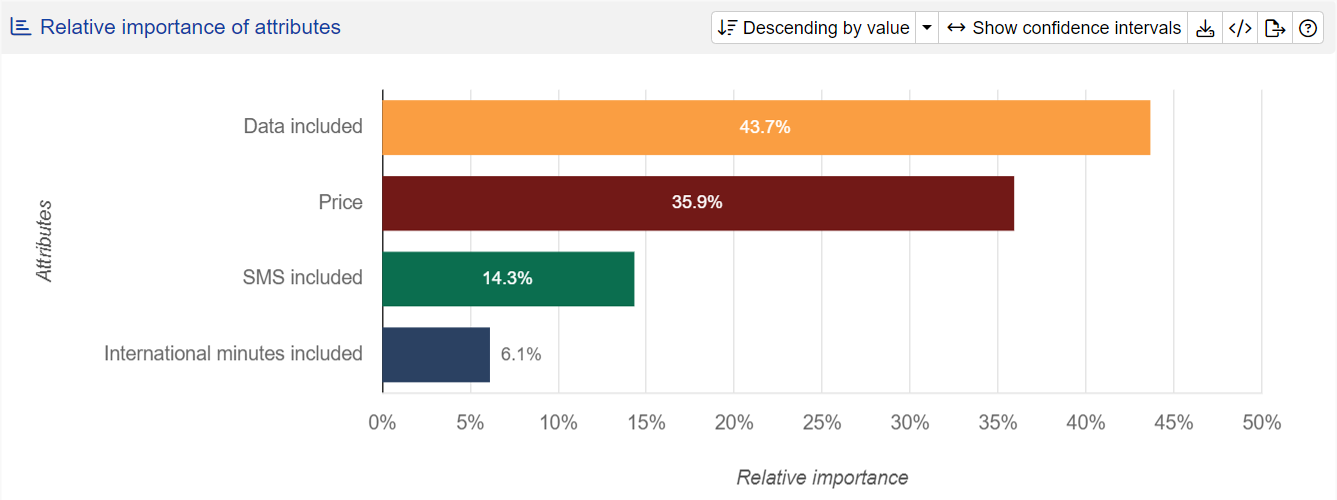
The relative importance of each attribute
Relative importance shows how much each attribute influences the final choice, expressed as percentages that add up to 100. It tells you which levers move buyers most, so you know where to focus.
The average preference for each level
Also called partworth utilities, this shows how much respondents prefer one level over another within an attribute. Higher is better, and a negative score drags a product down.

Because the scores add up, you can total the levels of any product to estimate its overall appeal, then compare products that do not exist yet, including combinations you have never put in front of a customer.
The marginal willingness to pay for each level
When price is included as one of the attributes, conjoint can translate the value of any level into dollars, indicating how much more or less a customer would pay for it.

The optimal combination of features and pricing
You can further analyse this data through a market simulator to predict the share each configuration would win, test a price change, or find the most profitable bundle. This is why conjoint is the standard choice for pricing strategy, feature selection, and claims testing.
For a complete overview, read the companion article to Conjointly’s Conjoint Analysis 101 webinar, which breaks down attributes, levels, experimental design, and results interpretation.
What MaxDiff reveals
MaxDiff, or Best-Worst Scaling, works on a single list of separate items rather than built-up products. The items might be 20 product features, 15 marketing messages, or a set of brand claims. There are no attributes, no levels, and no price, just a list of things competing with each other.
Respondents see a small set of those items at a time, usually four or five, and pick the best and the worst option in the set, on whatever dimension you are testing, for example most and least important, or most and least appealing.
Forcing a best and a worst choice is what makes MaxDiff powerful. Rating scales often run into an “everything is a 9 out of 10” problem, where respondents rate almost every item highly and nothing stands out. MaxDiff avoids this because every screen forces a real trade-off.

The survey rotates through the list across several screens, using a design that shows each item multiple times in different combinations. It does not pit every item directly against every other one. Instead it shows enough overlapping sets that the analysis can generate a score from the pattern of choices.
The relative value of each item
The relative value score sits on a common scale where all scores add up to 100. Because every item is being tested on its own, in effect as a single level, the score tells you how much more one item is preferred over another, not just the order.

A ranked list of the concepts tested
The ranked list carries the same information as the score, sorted from most to least preferred. It is a quick way for stakeholders to see the priority order at a glance.

And because it only ever asks people to compare a few items at a time, MaxDiff handles long lists comfortably. Respondents can work through 20, 30, or more items without fatigue.
How conjoint analysis and MaxDiff analysis differ
| Criteria | Conjoint Analysis | MaxDiff Analysis |
|---|---|---|
| What respondents see | Complete product profiles built from bundled features and a price | Small sets of individual items (e.g. features, claims) |
| Primary measurement | Real-world trade-offs between combined attributes, including price | Relative importance or preference, item by item |
| Item list capacity | Lower, typically capped at 6 to 8 attributes to avoid fatigue | High, can evaluate 20 to 40+ individual items |
| Willingness to pay | Built in natively through price-attribute trade-offs | Not measured on its own; needs a separate pricing method such as Van Westendorp or Gabor-Granger |
| Market share simulation | High-accuracy choice simulation and demand forecasting | Indicative preference share based on isolated scores |
| Best used for | Product line optimisation, tier packaging, pricing strategy | Claim testing, feature prioritisation, flavour or variant rankings |
The 6 to 8 attribute figure above is a rule of thumb, not a hard technical limit. It comes from how much a respondent can realistically weigh each option before their choice quality drops.
If you are looking to test more attributes, partial profile conjoint is a viable approach that shows each respondent only a rotating subset of your attributes per choice set rather than all of them at once.
When to use conjoint analysis vs MaxDiff
Choose conjoint analysis when:
- Your product or service is built from several attributes, each with levels, such as a mobile plan (price, data, contract length, network) or a snack bar (flavour, pack size, health claim, price).
- Price, bundling, or tiering is part of the brief, and you need to know how attributes trade off against each other. A feature that tops a simple ranking can be one customers refuse to pay extra for once it sits in a priced package.
- You want to build a simulator to model share, test pricing, or optimise bundles. For example, a beverage brand deciding whether adding a protein claim justifies raising the price from $3.49 to $3.99 a bottle needs conjoint to answer that.
Choose MaxDiff when:
- You have a flat list of standalone items to prioritise, such as 20 features, 15 messages, or a set of brand benefits.
- You want to evaluate items on a single dimension like relative importance or appeal.
- You want a fast, clean priority order without building a simulator. For example, a product team sitting on 30 new ideas with no reliable way to rank them needs MaxDiff to answer that.
In practice, the choice is often context-dependent, and the two methods don’t have to be mutually exclusive. In some cases, combining them in sequence can help you get more out of your research than running either one alone.
Combining MaxDiff and conjoint analysis
Suppose you have 30 candidate features and no idea which handful deserve a place in a conjoint study as running a conjoint on all 30 is not viable.
So you run a MaxDiff first, on the full list. MaxDiff ranks them cleanly and tells you which features people care about most. You then take the top six to eight and use them as the attributes in a follow-up conjoint, which works out how to package and price them.
On Conjointly, you can build that follow-up conjoint directly from your MaxDiff item list, so the winning features carry straight into the new study without re-entering them from scratch.
Common questions about conjoint and MaxDiff
A couple of questions come up often enough in demos and support conversations that they’re worth answering directly here.
Does conjoint analysis need price to be one of the attributes?
No, including price is completely optional, as a conjoint study effectively evaluates pure feature trade-offs on its own. This approach is particularly common when testing early-stage concepts prior to setting a price.
The trade-off is that without a price attribute, none of the willingness-to-pay outputs are available, only relative importance and preference share. If there’s any chance you’ll want a dollar figure later, it’s worth including price from the outset rather than re-fielding the study.
Can MaxDiff measure willingness to pay too?
Not on its own. MaxDiff ranks preference, not price, so you’ll still need a separate pricing method to put a dollar figure on anything, which is the one gap the comparison table above concedes.
With Conjointly, you can extend it rather than run a second disconnected study. Add Van Westendorp questions to a MaxDiff experiment, and it automatically generates a Feature Placement Matrix. With MaxDiff importance on one axis and Van Westendorp willingness to pay on the other, this sorts every feature into premium, add-on, every-tier, or deprioritise.
Is there brand-specific MaxDiff?
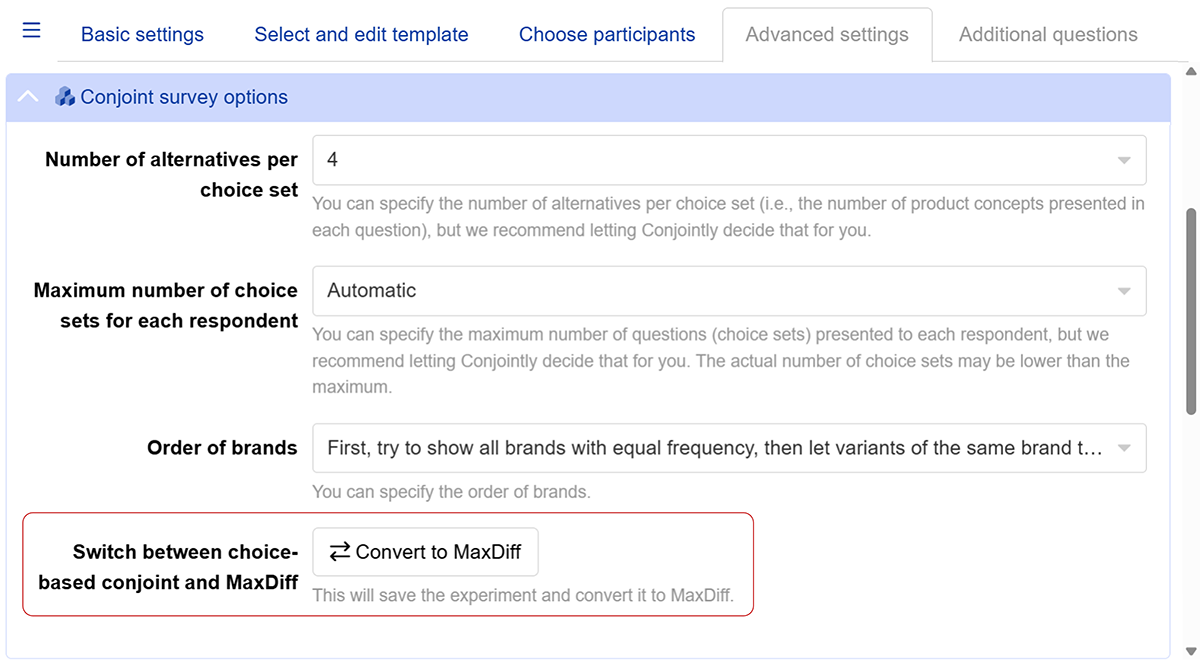
Not as a native standalone method. However, you can achieve it using a simple workaround by setting up a Brand-specific conjoint and assign the attribute levels that apply to each brand. Then convert it to MaxDiff under Advanced Survey Options with just a single click.
You can also convert a standard MaxDiff into a Conjoint at any point if your scope expands to include pricing and other attributes.
The recommendation still holds either way: use conjoint when price, bundling, or tiering is part of the question, and use MaxDiff when you need a fast, clean priority order from a longer list.
Conjointly builds each of these methods to the same standard of rigour, so whichever combination your project needs, the research team can help you land on the right approach. Book a call to discuss your project needs.
For a broader view of related methods, see the guides on alternatives to conjoint analysis and the classification of conjoint analysis types.